Fresh & Ripe
Stephen (Steve) Gallivan was born and raised in Boston, MA. In this memoir he reflects on what the city has meant to him and his family. For more on Steve see his military story under
They Remember War, this website.
On Boston
Steve Gallivan
Boston, Home of the Red Sox. It’s a city that loves sports: baseball, hockey, basketball, the Marathon; in fact, sports are like a religion in Bean Town. Like when the terrorists bombed the Boston Marathon in Copley Square, right in the heart of the city, it was like the desecration of the temple, it was like Lexington and Concord all over again with the natives rising up “from every village and farm.” And sports here is not just a guy thing. Young women learn the rules of the games too, like what the blue lines mean on the hockey ice and the red line, all that stuff. And don’t forget it’s the road to their lovers’s heart. Women understand this and they raise their kids, boys and girls, to play sports, any sport: field hockey, lacrosse, swimming, diving, any sport the kid can handle, not just Pop Warner. You get the picture?
Sports are in the blood here. But the Red Sox are special and their Fenway Park is their Vatican City. The Sox go way back, over a hundred years. Babe Ruth was their prodigal son, except he never came back, went to the Yankees, Babylon for pete’s sake! Boston, Home of the Red Sox! Something you can always talk about, like:“ Hey man, how’d The Sox do?” Something you learned about when you were ten-year-old kid; I mean everything about The Sox: all the players, batting averages, rbi’s, stolen bases, mvp’s, rookie of the year awards, and the pitchers too: kinds of deliveries, like side arm or overhand, speed of fast ball, the ones with a knuckler, strike outs, won-lost records, 20-game winners. And what you learned you not only never forgot but added to your encyclopedia every year:roster changes, retirements, manager changes, names of 3rd base and 1st base coaches. And although the players had at one time been kids themselves, they had morphed into forever baseball players, had no personal lives, just went home after the game and sharpened their spikes, stuff like that.
So when that woman shot Eddie Watkis, the hard-hitting 1st baseman for the Chicago Cubs, we ten-year-old kids thought she must be crazy or some kind of a spy, because Watkis was a very good hitter and a good fielder too, batted and threw lefty, like that. So for us kids these guys always stayed baseball players until they finally died. Even when they came out in wheelchairs as 90-year-olds for the ceremony at the season’s opener, they were still third base men or center fielders or pitchers and they all had nick names like us kids, like “Lefty’ or ‘Dizzy’ or Daffy’ and if you stuck your head in their car window after the game when they were on their way home and trying to get out of the traffic around Fenway Park and asked for their autograph you didn’t call them ‘sir’ or ‘Mr DiMaggio’ but “Joltin’ Joe’ and the thing of it all was that later in your life if you were in Berlin or Tokyo or the Sudan and were weeks without hearing your mother-tongue and you met a guy in a bar from Boston, well it was like being back home, you spoke the same language, hated the Yankees, remembered Bill Buckner’s error, and Ted Williams.
Now what does Ted Williams have to do with nurses? Well listen up!
The Chicago Cubs are in the National League but Boston used to have two major league teams, The Sox at Fenway Park and the Boston Braves at Braves Field about a half a mile away one from the other and that’s how come we all knew about Eddie Watkis, but the Braves left Boston and moved to Milwaukee. That hurt bad because the Braves were part of us and I’ll tell why in a bit, but we still had The Sox.
Right between Fenway Park and Braves field is the Boston Children’s Hospital. A doctor at Children’s Hospital had the idea of raising money to help his hospital expand its cancer-treating research program and laboratories by pressing the sports-button in Boston. You hear that? The sports-button! Holy mackerel!! Watch this: The Boston Braves joined this doctor in starting the Jimmy Fund for cancer research and then Ted Williams joined in, visiting sick kids in the hospital and the Jimmy Fund took off like one of Ted’s homers, and raised over 750 million dollars. What started out as a plan to raise enough money to expand a lab, turned into a twenty-story building of research labs because of those sports fans with deep pockets. That doctor’s name was Sidney Farber.
Then there was this pretty smart kid who decided to major in English Lit in college and for his doctoral dissertation he chose the subject of Roger Bacon being the real Shakespeare. In the archives he found a doctoral dissertation on exactly the same subject, written, submitted and approved 50 years before. He switched from English Lit to medicine. He went to work at Children’s Hospital Boston and got a Nobel Prize for making polio vaccine possible. The corner stone at the hospital’s new laboratories building has his name carved in it, John F. Enders.
So now here’s the story.
My wife calls me at work and says our 4-week old baby is on her way to Boston Children’s Hospital about 40 miles from where we live. Those famous painters liked to paint the Madonna with the child on her arm. I figured it was supposed to be the Virgin Mary holding baby Jesus. But you know what? It’s any mother like that. It’s a sight you will never forget especially if it’s your wife and your four-week-old kid.
Chemotherapy is given right off the bat, as soon as the x-rays and blood tests are in and the kids get them every day. At first every day for a month then once a week for three months and then once a month for a year and then once a year for three years or until there is no sign of a relapse. Only after a lot of visits do you finally notice the name on the cornerstone, John F. Enders, and from day one you can’t miss the giant picture of Ted Williams on the wall behind the info desk in the lobby. So it’s like the big three, Farber, Enders, Williams and they are on your team rooting for you. Big names, All Stars, Hall of Famers. Like I said, John Enders won a Nobel Prize. But it’s the nurses.
Here’s what it’s like: early every day, before 8 o’clock you ride the elevator to the eighth floor. It’s a giant elevator with front and back door, equipment, wheel chairs, patients, doctors, staff, visitors coming on and off and there is an elevator operator, an old guy, and then in the first waiting room you see the same kids and their parents, day after day so after a while you recognize them. Well, almost every day because even though the kids kind of look the same: bald, pale as ghosts and sitting very quiet like, something kids usually never do anywhere, but in fact as time goes by you will miss one of them when, damn it, that kid doesn’t show up.
Into thy hands I commend my spirit.
There’s a lot of waiting going on in the room and then you get called into another room where the nurses are in charge, about a dozen of them, going from kid to kid, talking real nice to them, checking names and scheduling the right medical procedure for each kid for that day. Each kid has a different type of cancer, and it’s like these nurses have "the gift of tongues," friendly words, reassuring tone, comforting all around and then these nurses take your kid away from you and you stay and wait some more.
They are out there walking around town, shopping, riding elevators , regular stuff like that, but you don’t notice them for what they are. They are like Clark Kent when they change into their uniform; they become like from some other planet. The children are commended to them in the waiting room after their informal hellos and words of comforting reassurance that never are abrupt but continue on from child to child like some lullaby which embraces the parents too. That on purpose. They are about their work in a happy way. It is the rule of their order of caregivers. They are always like that, day after day, week after week, never out of sorts. At first it takes you off guard because for you this may be a sinking ship, and they are acting like they don’t get the point, but they convert you as time goes by, at least to the point that it’s bearable, this torment, and there may well be hope and we take from them the lesson, the teaching that our suffering is not the point here, it is the children’s suffering. Grieving, if it comes to that, will be a self-comforting luxury. Later, but not here or now.
Then the kid comes back, you get some instructions for home nursing and you’re out of there. But you see, that last thing is not a guarantee. It’s by then after 5 o’clock. Nine hours. No matter, everybody’s going home. You don’t know whether to laugh or cry but because The Sox afternoon game is just breaking you ask the old guy running the elevator: “How’d The Sox do?” All the while those big names help, Farber, Enders, Williams. You know with them behind you are on the right track. But it’s the nurses.
“ ...If I live to be a hundred I’ll not know from whence or where “...come these women, comes this spirit.
The required years have gone past. The last visit is here. The treatments are over finished with one word - cured - one word. Speech fails us on the way down in the elevator. For heaven’s sake we’d liked to choke on the "thank you" to our last nurse. Choking up was never an option here. It’s the same old guy operating the elevator after all the years. Glad he never retired. Glad?! Hell, I’d like to kiss him. But I don’t. I don’t say anything but “How’d The Sox do?”
p.s. She’s over 40 years old now. Plays Bach, Mozart, stuff like that. Likes Sci-Fi and is a lot of fun to be around. They named a tunnel under Boston after Ted Williams, a roadway that will get you from the suburbs to Logan International Airport faster than Ted could go from 1st to 3rd, if you know what I mean. And the Jimmy Fund is still going strong, as is the hospital with John F. Enders carved in the cornerstone and called the Sidney Farber Cancer Institute.
Robert B. (Bob) Gentry is a retired educator, a freelance writer, and the coeditor of this website. For more information on him and his work see his links on the home page. The first two articles here are drawn from Gentry's insights and experiences during the Cold War.
Quest for Peace
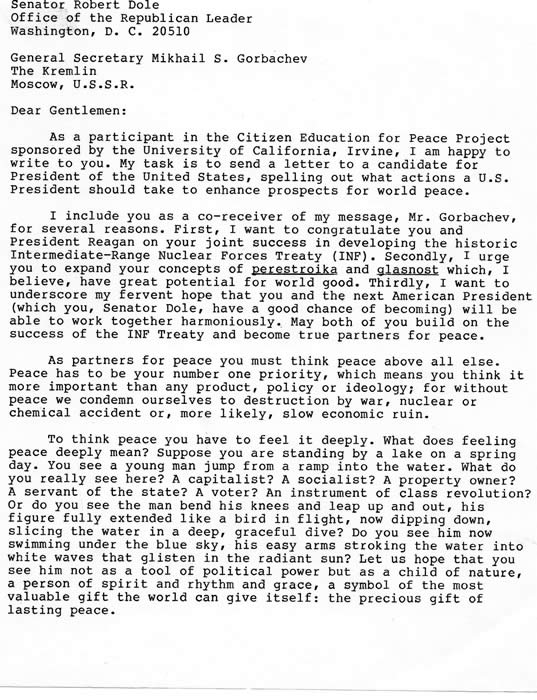
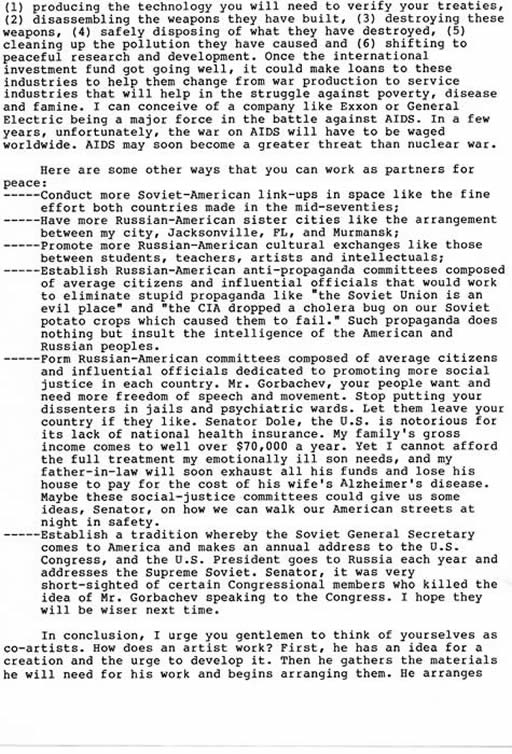
Ever since the Cuban Missile Crisis of 1962, which brought the world to the brink of annihilation, many people in the U.S. and around the world have been greatly concerned that governments work together to achieve a more peaceful planet. Unfortunately, some regimes would not allow a letter like the following. I wrote it Dec 14, 1987, when Robert Dole was running for president and looked as if he might win. I won a modest monetary prize for it. Misplaced for many years, the letter recently surfaced in one of my old files. It also appears at the end my Cold War story on this website. (They Remember War). I think it especially timely, given the dangerous tension between the Russian Federation and the U.S. over the crisis in Ukraine (spring, 2014).


Punished
Robert B. Gentry
Coming back from a leave I left the Autobahn and took a two-lane road--short cut. I needed to make good time to get back to Herzo Base before my 3-day pass expired at 1700. I wasn't terribly worried about being late. Unlike some outfits, in mine you didn't have to clock in when you returned from leave. Still, you always took a chance being off post without official permission. An MP might pull you over for some minor thing, see your expired pass, and write you up AWOL.
I soon had to slow up in a blanket of fog. Squinting to see ahead, I saw no vehicles. Figured I didn't have to crawl, so I gunned it a little--suddenly she loomed--Bump! We both pulled onto the shoulder and got out. I flicked my lighter. Dent on her Opel bumper. Dent on my VW bumper. Not too big but noticeable. She was nice. We exchanged addresses. In German I offered her 40 marks ($10, 1961 exchange rate). Said I'd cover whatever her repair cost was.
Danke aber das Auto ist versichert, she said.
I said the insurance company would surely contact the U.S. Army and I'd be in big trouble. I tried to persuade her to keep the matter just between us. But she said the Opel was in her husband's name and he'd want insurance to cover it. The CO's dire words boomed again in my mind, This battalion's setting a record in off-duty wrecks. Next guy has one, even a fender bender, I'm gonna throw the book at him.
Out of the fog two German cops, huge in their VW. One stayed in the car while the other questioned us. Of course we told him what happened. He told the other cop to call the MP's. I pleaded with them not to. Rules are rules, one said, and we all must obey them. Thirty minutes later I was written up in German and American accident reports. My fault!
When I got back to base several hours later, it was already on my bunk: Report to the CO, 0700. That night I went sleepless and sweaty, my mind roiling. I'd surely be court martialed, busted, kicked out of the Army, disgraced. Dad was a decorated combat veteran. I'd soon be a civilian bum, jobless. I wondered if garbage companies ever hired dishonored military.
At dawn I felt a flicker of hope: the First Shirt. Had to find the First Sergeant. Occasionally he'd get thirsty in the day. One time after my night shift, he rapped on my door and woke me:
Gentry, got anything in your locker? he whispered, his eyes always slightly crossed.
Out of Jack Daniels. How about Chevas Regal?
That'll do. Sorry to wake you.
I'll join you. It'll put me back to sleep.
I poured Chevas in Dixie cups. We sat on the bunk and talked booze. Good deals at the PX. Chevas on sale. By the weekend there'd be a special on Black Jack. Like a number of guys, I hid liquor in my locker and carefully removed it to my car before an inspection. Luckily, we never had any shake-downs. As far as we knew, Sarge was the only big dog on to the booze ruse. Now he gulped two big shots while I savored one. Bright-eyed, he said thanks, and with a spring in his step slipped out the door.
I figured he owed me one. But this morning I couldn't find him apart from the CO. There he stood beside the Lieutenant's desk. I saw nothing in either face--two stones. I thought, Hell, they're both gonna shaft me.
Specialist Gentry reporting, sir, and I snapped the CO a salute. He returned a snappier one. Steely-eyed, this regular Army officer. A year in his command and I'd never seen him smile. One guy said he had only two expressions: blank and grim. Perhaps he was insecure commanding a company of mostly one-hitchers, but it was hard to figure him. Fortunately, most of us didn't have to work with him. On the job we reported to our respective NSA section chiefs. Otherwise we only had to stay off his radar. But here I stood in his cold glare.
Specialist, I have two papers here, your name on each. This one is a Court Martial, this one an Article 15. My choice is Court Martial. The Sergeant has argued for Article 15, but of course I can overrule him and court martial you.
Agonizing pause.
Well? Was he giving me a choice?
May I request the Article 15, sir?
Another agonizing pause.
You may. Now get outa here. I saluted, did a jerky about face and rubber-legged it to chow, wiping my brow of cold sweat.
Confined to work, billets and mess hall for a month! No visitors except base GIs. No EM Club. No PX. No German-American Discussion Club where my lovely lady would surely miss me. About the time she sent me a love note, I heard N__ was getting very cozy with her. Green-eyed jealousy clawed at my heart. Black Jack gave little consolation. I vowed to kick N__'s ass when I got out of jail. Soon the fool that gave me the N report said he was joking and guffawed. I grabbed Farewell to Arms, threw a strike on his butt as he ran out the door.
Ah but relief: Love untainted. That month I read Doctor Zhivago and a lot of Hemingway.
[This piece also appears toward the end of my Cold War memoir in "They Remember War," this website.]
Light and Time in Virginia Woolf's To the Lighthouse
Robert B. Gentry
The central theme of To the Lighthouse (1927) is the human struggle against the ravages of Time. The story is set at the Ramsay summer home on the Isle of Skye in the Hebrides. As Eudora Welty observes in her Foreword to the novel, at this home with its "houseful of family and summer guests, on these few miles of shore and sea, with Lighthouse, life has been intensified, not constricted, not lessened in range but given its expansion. Inside, in the novel's multiple, time-affected view, is ever more boundless and more mysterious than Outside. And for the author, who is throughout this novel in her deepest element, there is more to risk, and farther to go." (viii)
Power and Beauty of the Lighthouse
The Lighthouse stands like a colossal character on a rock in the sea, a beacon to ships, a beacon to the Ramsay summer home. At the beginning of the story, the Lighthouse functions as a catalyst for Mrs. Ramsay's maternal love, for her intended charity toward the Lighthouse keeper and his disabled son, for child James' joyful expectation of visiting the Lighthouse, and for the cruel negativity of Mr. Ramsay and Charles Tansley who try to dash James' hopes of going there.
The Lighthouse figures poignantly in a high point of the novel: In a deep state of dark, comforting aloneness, Mrs. Ramsay contemplates the Lighthouse's three strokes of light. They combine with the solemnity of her solitude to give her a profound sense of "this peace, this rest, this eternity." (63) The third stroke, "her stroke" (63) she most identifies with, as shown in this marvelous epiphany whose spiritual and erotic overtones recall to me similar qualities in Bernini's The Ecstasy of St. Theresa:
[T]he steady light, the pitiless, the remorseless, which was so much her, yet so little her, which had her at its beck and call (she woke in the night and saw it bent across their bed, stroking the floor) but for all that, she thought, watching it with fascination, hypnotised, as if it were stroking with its silver fingers some sealed vessel in her brain whose bursting would flood her with delight, she had known happiness, exquisite happiness, intense happiness and it silvered the rough waves a little more brightly as daylight faded and the blue went out of the sea and it rolled in waves of pure lemon which curved and swelled and broke upon the beach and the ecstasy burst in her eyes and waves of pure delight raced over the floor of her mind and she felt, It is enough! It is enough! (65)
Near the end of the story the Lighthouse is a catalyst for the boat trip that Mr. Ramsay compels James and daughter Cam to take with him to the Lighthouse. This trip gets the intimidating Ramsay out of Lily Briscoe's hair so she can try to finish the painting she started ten years before. Her aim in the painting is to complete her vision of love for the Ramsay milieu, especially her love for the now dead Mrs. Ramsay by whom Lily still feels challenged. During the boat trip James and Cam vow to resist their father's tyranny but really don't. James seethes in silent hatred of his father until Ramsay praises his son's steering. Ironically, when they reach the Lighthouse, James and Cam apparently accept their father as he springs with new vigor from the boat onto the Lighthouse rock holding a parcel for the Lighthouse men.
Back on the house lawn, Lily and the poet Augustus Carmichael strain to see if the Ramsays have reached the Lighthouse, but it is "almost invisible" and has "melted away in a blue haze." (208) Lily and Carmichael, however, believe that the Ramsays have landed. Then the unsaid communication between painter and poet touches on the universal significance of the landing. I shall comment further on the last part of the novel in my conclusion below.
Mrs. Ramsay casts reflective light on nature.
Early in the story Mrs. Ramsay is looking through a shopping catalog hoping to find more pictures for her son James to cut out. As she turns the pages she hears the voices of men working and the sounds of children playing. When the sounds of men and children cease, she hears "the monotonous fall of waves on the beach" (15) and feels nature telling her, "I am guarding you--I am your support." Other times the same sounds make her "think of the destruction of the island and its engulfment in the sea," of her life passing away day by day, of the ephemeral nature of all things and she is suddenly seized with "an impulse of terror." (16)
These passages prompt me to look back a few paragraphs to that insensitive prig Charles Tansley who, like Mr. Ramsay earlier, tries to rain on James Ramsay's hopes of going to the Lighthouse. Mrs. Ramsay counters her husband and Tansley with words of encouragement and compassion to James: "Perhaps you will wake up and find the sun shining and the birds singing." (15) Like nature as destroyer, Tansley and Ramsay try to destroy the boy's joyful expectations. Like nature as guardian and comforter, Mrs. Ramsay tries to restore the boy's hope and joy. In the paragraphs immediately following the passage about nature's destructiveness, Mrs. Ramsay regains a sense of life's vitality in amusing, satirical thoughts of Charles Tansley; in listening to her husband reciting Tennyson, a sound "something between a song and a croak"; and in admiration of Lily Briscoe's independence. (16-17)
Nature as guardian, nature as destroyer--this duality anticipates similar dichotomies in Mrs. Ramsay's mind later in the novel. For example, when it looks as if her dinner party is going to fail, she wonders what she has done with her life, is momentarily alienated from everyone at the table, and feels "without hostility, the sterility of men." (83). She compares herself to a stopped watch, then gives herself "the little shake that one gives a watch that has stopped ticking" (83) and she begins to tick again as charming hostess and the dinner party progresses from there to one of grand success.
The ticking watch recalls the waves falling on the beach in the earlier passage, both keen metaphors for profundities of thought in the ultra-sensitive, compassionate mind of Mrs. Ramsay. In the earlier passage, the words consolingly, suddenly, unexpectedly, ghostly, remorselessly give a rolling quality like that of the waves she is contemplating, paradoxically melodic and haunting, ultimately thundering and terrible.
"The Second Coming" and To the Lighthouse
Though I can't say with any certainty that William Butler Yeats' famous poem "The Second Coming" directly influenced To the Lighthouse, I believe the poem shows in macrocosm certain characteristics that the novel reflects in microcosm.
"The Second Coming" (1919) expresses Yeats' view that the historical period begun with Christ is coming to an end. This "widening gyre" of history is spinning out of control and the declining center of Western Civilization (consisting of Judeo-Christianity and the Enlightenment tradition) did not prevent World War I; neither can it hold nor prevent what is occurring in Yeats' day: "anarchy" and "the blood-dimmed tide" (Anglo-Irish strife, the Russian Revolution and other violent happenings in Europe after World War I). In these situations, the poem's speaker says, "The ceremony of innocence is drowned" and "The best lack all conviction, while the worst/ Are full of passionate intensity." Echoing Yeats' belief that each person's mind is part of a universal consciousness or spirit of the world ("Spiritus Mundi" somewhat similar to Jung's "Collective Unconscious"), the speaker believes that "some revelation is at hand," which he calls "The Second Coming." However, he envisions not the Second Coming of Christ but the ominous coming of some strange, pitiless, sphinx-like thing that has nature in an angry tizzy ("the indignant desert birds.") The speaker loses the vision ("darkness drops again"); then he realizes that the historical period inclusive of the stony monuments of ancient Egypt, Greece, and Rome ("twenty centuries of stony sleep") was shaken to its core ("vexed to nightmare") by the rise of Christianity ("a rocking cradle") and eventually replaced by the Christian epoch. Finally the speaker wonders what new era is taking shape to replace the Christian one ("And what rough beast, its hour come round at last,/Slouches toward Bethlehem to be born?"). This era looks monstrous and disturbing as indeed it's turned out to be in the horrific wars of the 20th century and all the strife and bloodshed and unrest that have so far characterized the 21st.
In the novel the Ramsay summer home is a microcosm of English-Scottish life from 1910 to 1920 with significant Italian and French influences (Mrs. Ramsay's belief that she is of noble Italian blood and the French hit of her dinner party, Boeuf en Daube). The Ramsay summer circle has neither a religious center nor a philosophical one. Mrs. Ramsay dismisses the idea that "we are in the hands of the Lord;" (63) and asks, "How could any Lord have made this world?" (64); Charles Tansley is "the little atheist" (5); and Mr. Ramsay emerges as the big one, at least in his son's mind: "He rose and stood in the bow of the boat, very straight and tall, for all the world, James thought, as if he were saying, 'There is no God'." (207) Mr. Ramsay, metaphysician and professor, admits he will "talk 'some nonsense' to young men of Cardiff about Locke, Hume, Berkley, and the causes of the French Revolution." He also reduces David Hume, a major figure of the Enlightenment, to a fat philosopher stuck in a bog whom Ramsay feels free to laugh at.
The center of life at the summer home is Mrs. Ramsay, the spirta of her little mundi. She leads, animates, and unites her shaky family and moody guests. She suggests certain couples take beach walks that she hopes will be their first steps toward marriage. She arranges a lavish dinner party, which falters at first, then becomes a huge success largely due to her magnetic charm and the scrumptious Boeuf en Daube. Her biggest challenge (and chief antagonist in the story) is her husband with his titanic ego, overbearing need for sympathy, and morbid ideas in which he sometimes takes perverse delight. Mrs. Ramsay meets the challenge but with considerable strain and in the process she and Mr. Ramsay still manage to love each other.
But the center cannot hold. The marriage of Minta and Paul Raley, the couple Mrs. Ramsay swayed toward engagement, fails. The relationship of Lily Briscoe and William Bankes never gets beyond lukewarm friendship. Mrs Ramsay dies, apparently suddenly, in London. The blood-dimmed tide of World War I kills son Andrew Ramsay, and his sister Prue dies in childbirth. The surviving Ramsays abandon the summer home for ten years, probably because, like so many families of the time, they are economic casualties of the war. The home falls into disrepair, almost total ruin. Nature unleashes an anarchy of weeds and flowers that grow around and into the worn structure. Only through the heroic efforts of Mrs. McNab, Mrs. Bast, and the Bast son (three representations of the toil and tenacity of common humanity) is the Ramsay home restored to a semblance of what it was in 1910. Finally the Ramsay circle, terribly diminished by Time, returns again to summer there.
What have replaced Mrs. Ramsay are the artistic sensibility of painter Lily Briscoe and the doings of Mr. Ramsay, now a kind of pater/mater familias. Has Ramsay, the family "rough beast" (quoted term mine), whose monstrous egotism and awful mood swings loaded heavy burdens on his wife and children really changed for the better? Well, maybe a little in his fixing of picnic lunches for Cam and James, in praising his son's boating ability, and in carrying parcels of charity to the men of the Lighthouse, the secular "bethlehem" (quoted term mine), once the ideal destination for Mrs. Ramsay and child James. Yet there is no indication that he's lost much of his yen to intimidate and to dictate.
Speculation about Mr. Ramsay
It's interesting to speculate on what Woolf might have had in mind as Mr. Ramsay springs from the boat onto the Lighthouse rock and his children immediately get up and follow him as if he were a kind of charismatic leader. Might Ramsay with his new vigor and confidence, with his sense of total self-sufficiency, with his knowledge and ability to relate to and attract academics like Tansley and common men like Macalister, with his demanding personality and strong opinions, might he represent a kind of force? A force that has severed ties of traditional religion and philosophy, that has suffered from war, that thinks it knows exactly what needs to be done for self, family, and society, that does not hesitate to intimidate and dictate when these actions serve its aims of power.
By 1927 Stalin had powered his way to the head of the Soviet Union; Mussolini had been Il Duce of Italy for two years; Hitler had tried and failed to conquer Bavaria; the Nazi party was slowly growing; the second volume of Mein Kampf had been published; Josef Göbbels, a PhD in romantic literature with a large family, would soon become the propaganda voice of Nazism; and intellectual titans like Ezra Pound, Martin Heidegger, and Werner Heisenberg would remain loyal to the force of fascist boots. Might Woolf be using Ramsey as a "rough beast" to suggest a new totalitarian force or a composite of people highly susceptible to communism or fascism? Of course there is no concrete textual evidence for such a view. But Ramsey has the kind of personality that would make him a good fit in a totalitarian regime.
Virginia Woolf's artistic vision
In places this novel resonates with joy. In others it sounds wistful tones, a few of which border on despair. Most importantly, Woolf imbues her story with transcendent acceptance and affirmation. These qualities appear in various places in the novel, some of which I noted above. In the story's conclusion they shine forth with special intensity: for example in Lily's thoughts about Carmichael after the poet expresses his belief that the Ramsays have landed at the Lighthouse:
He stood there as if he were spreading his hands over all the weakness and suffering of mankind; she thought he was surveying, tolerantly and compassionately, their final destiny. Now he had crowned the occasion, she thought, when his hand slowly fell, as if she had seen him let fall from his great height a wreath of violets and asphodels which, fluttering slowly, lay at length upon the earth. (208)
Then comes Lily's completion of her painting in the final words of the story:
There it was--her picture. Yes, with all its greens and blues, its lines running up and across, its attempt at something. It would be hung in the attics, she thought; it would be destroyed. But what did that matter? she asked herself, taking up her brush again. She looked at the steps; they were empty; she looked at her canvas; it was blurred. With a sudden intensity, as if she saw it clear for a second, she drew a line there in the centre. It was done; it was finished. Yes, she thought, laying down her brush in extreme fatigue. I have had my vision. (209)
Like a light on the blurred canvas, the line clarifies Lily's vision of the essence of Mrs. Ramsay whom Lily has restored as the center of the summer home. Like everything else, Lily's painting has a beginning and an end. Though the work will probably be put away and eventually destroyed, for Lily and for Virginia Woolf it is the process that counts, the creative effort which affirms the power of art amid the impermanence of life.
To the Lighthouse is a story for the ages. It is all the more remarkable because despite recurring bouts of mental illness Virginia Woolf created it and other enduring works and became one of the greatest novelists of the twentieth century. Her early death represents a great loss to literature and compassionate thought.
Sources
Woolf, Virginia. To the Lighthouse. Foreword by Eudora Welty. Harcourt Brace & Company, 1927. Copyright renewed 1951 by Leonard Woolf. Foreword copyright 1981 by Eudora Welty.
Yeats, William Butler. "The Second Coming." The Bedford Introduction to Literature. Boston: Bedford Books, 876.
Love and Death in Cormac McCarthy’s The Road
(The Road won the 2007 Pulitzer Prize for Fiction and was adapted to film in 2009)
Robert B. Gentry
Robert B. Gentry's work on novelist Cormac McCarthy includes an essay on the novel Suttree in the Casebook You Would Not Believe What Watches: Suttree and Cormac McCarthy's Knoxville, 2nd. edition, published online by LSU Press and now an Amazon Kindle book (the print version of the Casebook 2nd edition will be published by the Cormac McCarthy Society if a grant for the project is approved). Since 2005 Gentry has been a regular contributor to the Cormac McCarthy Forum. He was acquainted with McCarthy when both attended schools in Knoxville, Tennessee. Gentry is the author of two college humanities textbooks: Twentieth Century Western Culture: An Introduction (Copley Publishing, 2000)and Insights into Love and Freedom (Copley Publishing, 2006). His essays and short stories have appeared in various media. Gentry's awards include a grant from The National Endowment for the Humanities, a Pushcart nomination for short fiction, the First Coast Writers' Festival's top award in short fiction, and a prize in the University of California's Quest for Peace Writing Contest. The following essay was published by Writecorner Press in early 2007.
A well-designed book gives vivid clues about its contents. So it is with Cormac McCarthy’s tenth novel, The Road.1
Book jacket: Mostly soot black. Title burnt umber, letters modulating and searing the darkness like sizzling embers. Author ash gray, his frayed letters like those of the title and the spine’s fiery identifiers.
Hard cover: Umber muted to rusty orange, front and back wordless. Narrow black border fused with black spine where identifiers are frozen in flame. Hold the spine up to the light: The title glows like a golden moon.
These tensions of color and line reflect major elements in The Road: fire as destruction, necessity, goodness; ash as poisonous residue of world cataclysm; the blackness of despair and death vs. the golden hope of life and love. Further, the novel's many page breaks do more than signal changing situations. Paradoxically, they provide spatial relief from the story's intensity and grip the mind with a sense of the tragic void of world ruin.
Told in spare prose like McCarthy’s No Country for Old Men, The Road begins with an unnamed man and his son shivering in dark woods somewhere east of the Mississippi River. The world has been devastated since shortly before the boy was born (of indeterminate age, he seems about 9 or 10). The disaster began with “a long shear of light and then a series of low concussions” that stopped clocks at 1:17 a.m. McCarthy does not specify the cause of the catastrophe or the time period of the story. He trains his keen eye on the effects as they impact the man and boy.
Hoping to escape the worst of winter, they head south on a highway, all they own in two knapsacks and the wiggly wheeled cart they push along. Over many weeks they trudge into a valley region, up through mountains, finally to the southeastern coast of what used to be the United States.2 Their canned food meager, soon gone. Their face masks scant protection against ash and dust. Landscapes burnt, barren. Trees black, crashing to the ground. Rivers rotten. No birds in the ash-gray sky. No fish in the dead sea. Houses and stores desolate. Vehicles empty wrecks. Grisly remains everywhere. Here corpses shriveled, mindlessly mummified. There bodies fried in asphalt. A human head wearing a ball cap, beneath a cake bell. Each day darker than the last! Fear and starvation plague the man and boy. Despair dogs them. Cannibals rob them, chase them.
Yet love keeps them going in a drama that glows with much tenderness between father and son. Will they survive? Is there any hope for the planet? These questions strike the reader with increasing urgency as conflicts dominate The Road, underscoring it as metaphor for the tragic journey of love and death. By isolating and focusing on elements that interrelate in the story, perhaps we can get a better grasp of how each contributes to the overall theme.
Man and boy vs. the environment. The man’s love for the child energizes his ingenuity. He knows how to fix things, how to improvise. When the mother gives birth, the man delivers the child making good use of kitchen materials. Through luck and his keen sense of search, he finds apples in an orchard, pure water in a cistern, useful supplies in a deserted house and sailboat. But danger keeps him and boy moving. Necessities are always scarce. Supplies critically short. The boy gets paler, thinner. The man coughs up blood. Like apocalyptic horsemen, hunger and thirst and disease and despair threaten to drive the man and boy into death’s corral.
Man vs. wife. Narrative flashbacks reveal a husband and wife who sat up many nights “debating the pros and cons of self destruction with the earnestness of philosophers chained to a madhouse wall.” (49) Their final argument may show traces of Keats and Freud, but I posit no borrowing by McCarthy of these writers. Rather I find them useful in approaching the complications between the man and wife.
In Keats’ “Ode to a Nightingale” the speaker’s “heart aches.” He yearns to “leave the world unseen,” to “fade far away” and escape a reality of pain “and leaden-eyed despairs.” Inspired by the melodious bird, he flies away “on the viewless wings of Poesy” and recalls that “many a time/ I have been half in love with easeful Death.” As the bird reaches “an ecstasy” of song, the speaker muses, “Now more than ever seems it rich to die.”
Similarly, the wife in The Road is heart sore, wants to go off alone and escape the world, and speaks lovingly of death. Otherwise, she is the polar opposite of Keats’ speaker. Her mood and words are grimly prosaic, her situation dire. When the husband mentions that they’re survivors, she berates him:
We’re the walking dead in a horror film....You can’t protect us. You say you'd die for us but what good is that? ....Sooner or later…they [cannibals] are going to rape us and kill us and eat us and you won’t face it. You’d rather wait for it to happen. But I can’t….I’ve taken a new lover. He can give me what you cannot….(47-48)
“Death is not a lover,” (48) the man counters. He begs her to choose life, but like the character White in McCarthy’s play The Sunset Limited, she sees life as meaningless and is bent on suicide:
I should have done it a long time ago…. I am done with my own whorish heart and I have been for a long time. You talk about taking a stand but there is no stand to take ….My heart was ripped out of me the night he [the boy] was born so don’t ask for sorrow now….[Y]ou won’t survive yourself. I know because I would not have come this far. A person who had no one would be well advised to cobble together some passable ghost. Breathe it into being and coax it along with words of love. Offer it each phantom crumb and shield it from harm with your body. As for me my only hope is for eternal nothingness….(47-48)
In Freudian terms the wife makes a stronger case for death (Thanatos) than the man makes for life (Eros).3 She plans to kill herself “with a flake of obsidian” (49) that ironically the man taught her how to use when he was considering suicide. She leaves without saying goodbye to her son, and the boy shows no concern about her departure. Undoubtedly she is self-absorbed and wracked with despair. Does she suggest something else? Did she hate to bring a child into the ruined world? (“my heart was ripped out of me the night he was born”) During years of hardship did she cobble together a dutiful attachment to son and husband? Did she prostitute herself to help the family cope with want and suffering? (“my own whorish heart”) Is she saying that a “passable ghost” of love is the only positive left? Has she left most of the parenting to the man and thus alienated the child? Does she feel guilt and seek to end it in death? Is she nobly removing herself to give the man and boy a better chance at survival? Given what the story reveals about her, these questions have no conclusive answers.
This writer is left pondering the wife as a measure of the gulf between romantic death in nineteenth-century writers like Keats and starkly realistic death in contemporary authors of whom McCarthy is one of the best.
Man vs. boy. The fear the boy feels on the road, the terrible things he sees depress him. At one point he gets so down he says, “I wish I was with my mom.” The man’s attempt to stop his son’s dejection ends in uncertainty:
“You mean you wish that you were dead.”
“Yes.”
“You mustn’t say that.”
“But I do.”
“Don’t say it. It’s a bad thing to say.”
“I can’t help it.”
“I know. But you have to.”
“How do I do it?”
“I don’t know." (46-47) 4
The man gives all his love to the golden-haired child. Anyone else he fears and suspects: They could be “road agents” or “blood cults” (types of cannibals). The man’s exclusivity is like an extreme version of Freud's idea of love:
[L]ove...imposes duties on me for whose fulfillment I must be ready to make sacrifices. If I love someone, he must deserve it in some way….He deserves it if he is so like me in important ways that I can love myself in him; and he deserves it if he is so much more perfect than myself that I can love my ideal of my own self in him….But if he is a stranger to me and if he cannot attract me by any worth of his own or any significance that he may already have acquired for my emotional life, it will be hard for me to love him….Not merely is this stranger in general unworthy of my love; I must honestly confess that he has more claim to my hostility and even my hatred. He seems not to have the least trace of love for me and shows me not the slightest consideration. If it will do him any good he has no hesitation in injuring me, nor does he ask himself whether the amount of advantage he gains bears any proportion to the extent of harm he does to me.5
In contrast, the son in The Road is inclusive and compassionate by nature and for a time naively so. He wants to reach out to a stray dog, to a man struck by lightning, to a little boy. The father won’t allow any of it. Too dangerous! Despite their caution, a cannibal grabs the boy. The father shoots the man and washes brains out of his son’s hair. Shocked, the boy clams up. In the process of getting the boy to talk, the father sounds a bit like a biblical patriarch:
“You have to talk to me.”
“Okay.”
“You wanted to know what the bad guys look like. Now you know. It may happen again. My job is to take care of you. I was appointed by God to do that. I will kill anybody who touches you. Do you understand?”
“Yes….Are we still the good guys?”
“Yes. We’re still the good guys.”
“And we always will be.”
“Yes. We always will be.” (65-66)
The boy heeds the father, gets more cautious. Still, tension arises when they meet Ely, the only named character in the novel. The father thinks he may be a decoy for road agents. But he turns out to be a fearful, starving, half-blind old man who says some strange things. The boy wants to feed him and take him with them on the road. Grudgingly, the father allows Ely a little food and an overnight stay.
Later when they catch a thief with their supplies, the father makes the man strip, takes his clothes, and leaves him naked and shivering. The son pleads and cries and finally turns the father from blind hatred to a reluctant sense of justice. They conduct a risky search but can’t find the thief. This scene concludes sadly:
Finally he piled the man’s shoes and clothes in the road. He put a rock on top of them. “We have to go,” he said. “We have to go.” (219)
These lines contain a technique seen often in McCarthy’s work. Rick Wallach calls it a “blurring or recombinance of identity.” 6 The blurred he ironically joins father and son in resolution (their intent to return the thief’s clothes) and a futile attempt at restitution.
Man vs. man. Like Outer Dark, McCarthy’s second novel, The Road contains horrible scenes of cannibalism. On the run, the man and boy see how road agents enslave people before eating them and other ghastly results of what seems to be the only enterprise on earth. Besides the physical challenge of cannibals, Ely presents a spiritual challenge.7 In strained conversations with the man, Ely makes contradictory statements about his age and about living on the road, says his name is not Ely, and won’t give his real name because he can’t trust anyone with it.
When the man conjectures that God would know who the last man on earth is, Ely says, “There is no God and we are his prophets.” (143)The man asks, “What if I said he’s [the boy’s] a god?” Ely shakes his head and replies, “I’m past all that now. Have been for years. Where men can’t live gods fare no better. You’ll see. It’s better to be alone.” (145)
Some of McCarthy’s work shows the influence of Nietzsche, and Ely may be another example. In Thus Spoke Zarathustra, Nietzsche’s hero and alter-ego proclaims the potential of human energy to create a new consciousness that will give rise to the “Ubermensch” (an intellectual superman). Without this creative energy, Zarathustra envisions the world degenerating into a herd of "last men” where “everyone wants the same; everyone is the same”:
I tell you, one must still have chaos in oneself to be able to give birth to a dancing star. I tell you: you have still chaos in yourselves. Alas! There comes the time when man will no longer give birth to any star. Alas! There comes the time of the most despicable man, who can no longer despise himself. Lo! I show you the last man. "What is love? What is creation? What is longing? What is a star?" so asks the last man, and blinks. The earth has become small, and on it hops the last man, who makes everything small.8
Like the “last man,” Ely shows no sign of creative fire, no will to power. When the boy offers him food, the old man blinks, an act suggestive of his physical and spiritual debilities. Unlike Zarathustra, Ely cannot imagine anything beyond the hapless equality of which he is a feeble, shrinking part. “Nobody wants to be here and nobody wants to leave,” (143) he tells the man. “I’m just on the road the same as you. No different”…. “I could be anybody”…. “I’m not anything.” (144-145)
Contentment is a major trait of the Nietzschean last man. Similarly, Ely seems content to drift pathetically along without identity, without compassion, without trust, barely subsisting. Like the man’s wife, he hopes for nothingness, but his view of death is more inclusive than hers and it smacks of comic nihilism:
Things will be better when everybody’s gone….We’ll all be better off. We’ll all breathe easier….When we’re all gone at last then there’ll be nobody here but death and his days will be numbered too. He’ll be out in the road with nothing to do and nobody to do it to. He’ll say: Where did everybody go? And that’s how it will be. What’s wrong with that? (145-146)
In his final words, however, Ely undercuts all his ideas by his denial of luck: “I don’t know what that would mean. What luck would look like. Who would know such a thing?” Interestingly, the man and boy have the last word on him. Boy: “He’s going to die.” Man: “I know.” (147) [Boy and Man in bold are mine.]
Man vs. himself.
Like his major influencer, William Faulkner, McCarthy has created memorable characters that poignantly show “the human heart in conflict with itself.” 9 These include Cornelius Suttree in Suttree, the Kid in Blood Meridian, Ed Tom Bell in No Country for Old Men, and the father in The Road.
Gloom and doom in the father’s outer life distort his inner life. Nightmares torture his sleep and that of the boy. His desperate efforts to live and protect his son have sapped his will to be school teacher and storyteller to the boy. He finds it harder to think of things to say. He worries that he is forgetting colors, the names of birds and of things to eat. He is most fearful of losing the names of things he believes to be true and darkly envisions the loss of all his belief. Thus he exemplifies a kind of mental loss that would likely occur in people barely subsisting in a ruined world.
The man tries to wipe the wife out of his mind, even leaves her picture on the road, but she enters his “rich dreams” (111) and some of his waking memories. He thinks such visions are self-defeating, tries to dismiss them. But they reassert themselves in various forms only to be deconstructed by harsh reality. For example:
There were times when he sat watching the boy sleep that he would begin to sob uncontrollably but it wasn’t about death. He wasn’t sure what it was about but he thought it was about beauty or goodness. Things that he’d no longer any way to think about at all. (109)
A part of him wants it all to end: “There were few nights lying in the dark that he did not envy the dead.” (194) He even has a suicide plan for the boy and himself. But a stronger part of him vows to go on living as long as he can for the sake of the child. At one point, he urges the fearful boy to help him open a door that will lead to an underground bunker. "This is what the good guys do," he tells the child. "They keep trying. They don’t give up.” (116) He assures his son that they would never eat anybody even if they were starving because “we’re the good guys…and we’re carrying the fire.” (109)
This association of fire with the father-son relationship recalls Ed Tom Bell’s dream of meeting his fire-carrying father in a mountain pass at the end of No Country for Old Men:
…I seen he was carryin fire in a horn…and I could see the horn from the light inside of it. About the color of the moon….I knew that he was goin on ahead and that he was fixin to make a fire somewhere out there in all that dark and all that cold and I knew that whenever I got there he would be there.10
While the fire of goodness in The Road shines ever bright in the boy, it sometimes dims in the man but is never lost. Beauty he represses, but it resurrects in recollections: of flashing trout he once saw in a mountain stream, of his wife “in a thin rose gown that clung to her breasts”;(111) in dreams “of softly colored worlds of human love, the songs of birds, the sun.” (229)
The child: part father of the man. Guided by the father, the son grows in perception and purpose. Well before the end of the novel, he and the man approach some situations and make decisions about them on a near-equal basis. At a critical point, the boy's detective work leads the man to the thief. Whenever the father must go off to check for danger or search for supplies, the boy reluctantly takes the pistol from the man, but he shows no clear resolve to follow the man’s instructions and shoot himself if things get completely hopeless.
The boy’s ideals take mature form, are tempered by common sense, but never compromised. In the vehement argument over the thief, when the man snaps, “You’re not the one who has to worry about everything,” the boy makes a decisive point: “Yes I am”… "I am the one.” (218) These words convey the child’s sense of adult responsibility. They suggest that he must worry not only about the physical danger of cannibals but also about the spiritual danger of hardness of heart. In persuading the father to return the thief’s clothes, the son leads in taking compassionate risk for the sake of justice. Thus he acts as a kind of guardian angel.
Later, to the dying father the son stands “glowing in that waste like a tabernacle.” (230) When he kneels and hands the man a cup of water, the boy has a halo of “light all about him,” (233) and when he moves away with the cup, the light moves with him. His angelic aura, however, does not obscure the fact that in some ways he is still an unsure, fearful child in need of guidance and the father provides it.
He tells the boy that he's too sick to go on, advises him to keep going south, and speaks to him words of love: "You have my whole heart. You always have." (235) The father's affection here sounds like that of Ed Tom Bell for his wife Loretta: "That's my heart yonder...It always was." 11 The father says that he can see the fire of goodness in his son, death won't separate them, and after he's gone they can talk to each other: "You have to make it like talk that you imagine. And you'll hear me. You have to practice. Just don't give up. Okay?" "Okay," (235) the boy answers maturely with renewed hope. Some hours later, the father falls asleep in his son’s arms and dies during the night.
The ending: hope vs. ambiguity. The son mourns the father for three days and then he encounters a rugged, bearded, scar-faced man. This “veteran of old skirmishes” wears a gray and yellow parka, carries a shotgun, and speaks and smiles “imperfectly.” The boy points his pistol at the man and asks, “Are you one of the good guys?” (237) The man removes his hood, looks at the sky, and says he is. Is he a road agent who just stalls long enough to think up a lie? Or is he a symbolic savior who has come to rescue the boy?
The man’s facial expression, matted hair, gun, and bandolier of ammunition could describe a cannibal. However, he looks, talks, and acts like a universal good figure. He wears a parka; the boy’s father wore a parka. The yellow color of his jacket matches the boy’s hair. He lets the boy keep his pistol, wraps the dead father in a blanket, and gives the boy a choice of going with him or not. When the boy decides to go with him, the man waits a long time for him to cry and look mournfully upon his father for the last time. Moreover, the man lives with a woman and they have a boy and a girl of their own. The woman gives the orphan boy a warm welcome, and “[s]he would talk to him sometimes about God.” When the boy says the best thing he can do is to talk imaginatively to his dead father, the woman approves and speaks of the breath of God passing “from man to man through all time.” (241)
Following the woman’s comment about the breath of God is the last paragraph of the novel, one of the most ambiguous passages that I have ever read. Here the narrator recalls trout that once swam beautifully and tellingly in mountain streams, fish that
smelled of moss in your hand. Polished and muscular and torsional. On their backs were vermiculate patterns that were maps of the world in its becoming. Maps and mazes. Of a thing which could not be put back. Not be made right again. In the deep glens where they lived all things were older than man and hummed of mystery. (241)
A world that cannot be put back and made right again suggests hopelessness, a descent into a soulless void. Faulkner’s inspiring vision has not been realized. Humanity has neither endured nor prevailed.12
But the sun still shines though dimly. Rain and snow still fall. One can find pure water and part of the land still bears fruit. People still have children and some believe in the immortality of the soul.
Perhaps the orphan boy, his new family, and other good guys live in deep glens as people did before the catastrophe.
Perhaps in these glens a new world is becoming and it hums with the mystery of life.
Notes
1 Cormac McCarthy. The Road. Alfred A. Knopf, 2006.
2 I grew up in Knoxville, Tennessee, and attended the same grade school and high school as McCarthy at times when he did (1942 -1951). Though barely acquainted with him and some of his family then, I remember some things about him and where he lived. On the road the man and boy see a Rock City sign, an indication that they are nearing or in Tennessee. The city they pass through bears some resemblance to Knoxville and the bridge they cross recalls Knoxville’s Henley Street Bridge. According to Professor Wes Morgan, a McCarthy scholar at the University of Tennessee, the exterior of the home the man and boy visit looks like that of McCarthy’s old family home in South Knoxville. From there they trudge out Chapman Highway (Hwy 441), through a ruined resort town (Gatlinburg, Tenn.) up into mountains (Smokies), through a gap (Newfound Gap), and eventually to a coastal area which may be that of Charleston, SC.
3 For more on Eros and Thanatos see Chapter VI of Sigmund Freud's Civilization and Its Discontents. Ed. James Strachey. W. W. Norton and Company, Inc., 1961.
4 McCarthy dislikes commas, uses few apostrophes and no quotation marks. For the benefit of readers unfamiliar with his work, I have added quotation marks and apostrophes.
5 This passage and more of Sigmund Freud on love and aggression appear in Chapter V of Civilization and Its Discontents.
6 See the nineteenth paragraph of Rick Wallach’s Theater, Ritual, and Dream in the Border Trilogy, Fresh and Ripe section, this website.
7 The name Ely recalls Eli of the Book of Samuel; Elijah, the Old Testament prophet; and Eli in the cry of dying Jesus on the cross, “Eli, Eli, lema sabachtani” (My God, my God, why hast thou forsaken me?). Unlike Elijah, Ely in The Road heralds no messiah. Whereas Elijah is a strong prophet of all powerful Yahweh, Ely is a weak prophet of nothingness. Unlike Christ on the cross, Ely lacks compassion and struggle. He is perhaps closest to Eli, the priest at Shiloh whose family was destroyed as foretold by Yahweh. Eli lived to be a blind, very old man who died when he heard about the theft of the Ark of the Covenant.
8 This passage appears in the Prologue of Friedrich Nietzsche’s “Thus Spoke Zarathustra” in The Portable Nietzsche, edited and translated by Walter Kaufmann. Viking Penguin, 1982.
9 From William Faulkner’s 1949 Nobel Prize Speech. Nobel Prize Foundation.
10 No Country For Old Men. Alfred A. Knopf, 2005, 309.
11 No Country For Old Men, 300.
12 Faulkner’s Nobel speech ends thus: “The poet’s voice need not merely be the record of man, it can be one of the props, the pillars to help him endure and prevail."
Authors | Home | Top
_________________________________________________________
Tom Glenn lives in Ellicott City, Maryland. His stories have appeared in The MacGuffin, Potpourri, The Baltimore Review, and Antietam Review among others. He won the Hackney Literary Award and the grand prize in the 2004 Maryland Writer's Association novel competition. His work has been nominated for a Pushcart Award and a Baltimore ArtScape Literary Award.
Many of Glenn’s stories come from the better part of thirteen years he operated under cover in Vietnam. Nearly all his writing is, in one way or another, about fathers and children (he has four) and is haunted by his five years of work with AIDS patients (all gay, all died), two years of helping the homeless, and seven years of caring for the dying in the hospice system.
"Short-Timers" won the prestigious 2008 Page Edwards Award for Short Fiction and appears in The Book of Scars, a prose collection work. "The Gift of the Father" was first published in The Seven Hills Review.
Short-Timers
Tom Glenn
It was the M-16 that started me with them. The Major gave it to me my first night on Cobra Mountain, the same night I came down with a cold. We were outside the officers’ club tent sipping Bloody Marys and watching the twinkles from skirmishes in the valley far below.
“Keep your weapon cleaned and oiled,” the Major said. “Carry it with you at all times. The lull could end without warning.”
I gave him a smile. “I’m a reporter, not one of your soldiers.”
I kept the M-16 in the transient tent, pitched on the western slope of the mountain, above the main camp and a couple of hundred feet from the crest. No electricity—generators, cranked up at night, were for the Officers’, NCO, and EM club tents. I wrote in the afternoon with the blinding sun and gritty December wind at my back and used empty ammunition clips to hold down my papers. Even though I kept my typewriter in its case and covered with plastic, I had to clean out blood-red dust every time I used it.
My second week there, two guys in the main camp further down the mountain caught my eye. Hammering and sawing and getting in each other’s way like silent movie comedians, they were stripped to the waist and shining with sweat despite the snap in the air. I put on my fatigue cap, covered my typewriter, grabbed the M-16, and walked down to the battalion street.
The guy in charge was a big kid, maybe nineteen at the most, with a handle-bar mustache, glasses, and wide eyes the color of smoke.
“What’re you up to?” I asked.
The other kid, a beanpole with olive skin and blue-black hair, stopped hammering and swept me with his eyes. “He must be a nug, Bear. Look at his boots.”
Bear looked at my boots. I looked at my boots. Then I saw the difference. Theirs were half canvas and half leather. Jungle boots. Mine were standard state-side issue, all leather.
The guy with the hammer smiled. “We’re building the club, the new club, so’s we won’t have to use a tent no more.” He held out his hand. “Tony di Franco. And the hulk is Bear Thorenson.”
“Larry Anderson. What’s wrong with using a tent for a club?”
They were still staring at me when a little black guy stumbled up. His fatigue hat was pulled down to his purple aviator sunglasses. His Afro and mustache were out of control.
“This here’s Diver,” di Franco grinned. “What’s the deal, Dive? Head fucked up?”
Diver shuddered.
DiFranco’s black eyes danced. “Diver had a little drunkie last night.”
“So everything’s normal, right?” Bear said. “So let’s get to work.”
They resumed their hammering and sawing. Diver, wrapped in his fatigue jacket, moved like a whipped bantam.
“Hey,” I said. “Could one of you guys show me where to get some stuff to clean my M-16?”
Bear stopped sawing. “Dive, you ain’t worth a damn anyways. Take the nug over to the cleaning tables.”
Diver dropped his hammer and started down the battalion street. “What the hell you waiting for?”
At the cleaning tables, he pointed to the solvent and oil and slumped on the ground in the shadow of a tent.
“How about some help?” I said.
“Go straight to hell, mother fucker.”
“Hey, buddy, I haven’t cleaned a rifle in ten years.”
He eased off his glasses, scanned my face with bloodshot eyes. and took in the unmarked fatigues and the boots. “Who the fuck are you?”
“Larry Anderson. Reporter for Pacific Press International.”
“Oh, lovin’ Jesus.” He put on his glasses and pulled the bill of his cap down as far as it would go. “Shit, I thought you was a nug.” He got up and snatched my rifle.
“I’ll do it,” I said. “Just show me how.”
He went on working as if he hadn’t heard me. He cleaned and oiled the weapon faster than I’d ever seen it done and handed it to me. “Man, don’t tell the beggars you saw me hungover, and don’t write about me in your story. Deal?”
“What’s a nug?”
For the first time he smiled. Only a faint smile, but he was a different man when he smiled. “Tell you what.” He rubbed his palms together and paced. “I’ll clean your weapon long as you’re here, and you let me stay out of sight.” He extended his hand, and we shook on it. “A nug is a new girb.”
“A what?”
“A new GI rat bastard. A tenderfoot. Wet behind the ears. Can’t find the latrine or his ass in the dark. Can you hear me?” “I hear you.”
“Smooth.”
He pulled his cap down and headed up the road. I scrambled along behind.
At the building site, he told the others who I was. In the silence that followed, I could hear the wind moving through the tents.
“How about if I give you a hand?” I said.
They glanced at each other sidelong.
Bear tried to figure out what to do with his hands. “Fine, sir,”
I worked with them the rest of the afternoon. They were the worst carpenters I’d ever seen—mismeasuring, sawing crookedly, bending nails, then pounding them in—and I had to bite my tongue to keep from coaching them. When the sun disappeared behind crags on the other side of the valley and the wind turned cold, they went off to their tents to get ready for guard mount. They’d be on the perimeter until midnight, they told me, then be relieved by another crew. All three were short-timers—due to rotate back to the states within the next sixty days—so they worked details six hours a day and had guard six hours. They’d keep at this routine until some action broke the lull.
The next day, they didn’t show up at the site, so I worked alone. Turned out they’d been pulled off for another detail. The construction of the EM club wasn’t a high priority to the brass.
By the time I got there the following day, Bear was inspecting the frame. Di Franco was picking his teeth. He sniffed like something smelled bad. Diver sat on the ground with his knees against his chest and his hands in his pockets. He’d pulled his cap down over his face, and the hair on the back of his head stuck out like dyed cotton batting.
Bear scowled at planks I’d hammered in place. “Who did all this stuff?”
“Sorry, guys,” I said. “Since you couldn’t be here to work, you know—” I stopped talking. I’d fucked up.
Di Franco flashed his grin. “You done good, sir. We need all the help we can get.”
Bear snorted, hacked, and spat.
“Why do you care so much about it?” I asked.
Bear gave me the expressionless look enlisted men reserve for dumb officers.
“Sir,” di Franco said, “it’s going to be our club, and we want it to be good. They won’t let nobody but three guys work on it, so we’re trying to get it finished quick and do a good job all the same.” He kicked the dirt. “I mean, like, you know, it’s Our Club.”
Bear scratched his armpit. “We appreciate your help, sir.” He swallowed hard. “And we’re proud to have you working with us.”
After that, each day I was in camp I worked beside them. Bear watched me out of the corner of his eye to see how I drove a nail without bending it. Di Franco asked me to show him how to saw a board straight. I taught them what a plumb line was and how to use it to keep the frame vertical. Now they greeted me happily as “Mr. Anderson” or “sir.” I wasn’t one of them, but at least I wasn’t a beggar any more.
Di Franco I liked because he was a con artist and loved to make a fish out of anybody who’d fall for his scam. Bear was a good kid, quiet and serious.
Diver was something else. Not more than five foot eight or nine and wiry, he came to life by mid-afternoon and bopped to the music in his head, shoulders forward, hands cupped, legs bent, chin bouncing. The lines in his face seemed temporary, as if a good night’s sleep would erase them. His voice cracked like an adolescent’s. His chocolate eyes boogied.
. . .
I savored the time I spent with The Short-Timers, as I called them in my mind. They swaggered the way only young men can. Their masterful use of sexual expletives and street lingo made me smile. They horsed around and engaged each other in a ritual dance about the passage to manhood through war and killing. In their unfinished faces I saw sweetness hidden beneath the fear they concealed by blanking the feeling out of their eyes.
One-thirty Christmas morning, after the O Club tent closed, I stood shivering in the moonlit battalion street. Across from me was the EM club tent. Did I really want to barge in? What if they threw me out? The wind was cutting through me. I needed company. I pulled back the flap and went in.
Opposite the door was a ten-stool bar next to a platform with stereo speakers booming “Don’t Sleep in the Subways” and a fake Christmas tree rigged out with paper candy canes and a sagging star. Between me and the bar were half a dozen tables of different sizes and a collection of chairs stolen from twenty different places. The dirt floor was red, like all the earth around here. Cigarette smoke dimmed the glow from candles. The only electric light was a naked bulb hanging over the bar. Thirty or forty men were drinking, laughing, talking.
“Mr. Anderson,” came a voice from the bar. It was Bear. “You decided to come see how the other half lives.”
The talk stopped. The music played on.
I crossed the tent among the upturned faces and blank eyes.
“Sam,” Bear said to the GI tending bar, “give the man a drink. What’ll it be?”
“Johnnie Walker Black on the rocks.”
“Diver, hear that?” Bear called over his shoulder to the closest table. “The man drinks Black Label on the rocks.”
“Mr. Anderson!” Diver got out of his chair, waved to di Franco to follow him, and tottered toward me, grinning. He clapped a hand on my shoulder. His eyes came in and out of focus. “Hell, we thought you was happy with the beggars.”
“Sit down, Mr. Anderson.” Bear pulled up a stool.
“Make it Larry.”
Diver offered me a cigarette and lit it for me. Immediately I began to cough and blow my nose.
Di Franco gave me a grin full of mischief. “You got that coughing routine down real good. That only proves you’re a nug. Nugs always get colds.” His grin widened. “But we know how to fix ’em.”
“Sam—” Diver said.
The bartender pushed a bottle of Old Crow, a tumbler, and a bag of sugar onto the bar. Diver seized the bottle and tumbler and threw an arm around my shoulder, barely missing the bar with the bottle. “Slog down what I fix you, man. You’ll be in great shape tomorrow.”
The others howled.
Diver glowered. “Man, don’t laugh like that. It ain’t saltpeter.” He filled the glass one third with bourbon and dumped sugar into it. Sugar flowed over the bar and ran onto the floor. “Nit noy. Won’t hurt nothing. There you go, Mr. Anderson. You chug-a-lug that.”
“Larry.” I stirred the sugar-clotted bourbon with my thumb. “Jeez, I’ll barf all over the club.”
Sam slammed a second tumbler on the bar. Diver prepared another Old Crow and sugar.
“Now, Larry,” he said, his voice breaking, “this here is the Cobra Cold Cure. You drink as many of these as you can without passing out and you go to bed with a bunch of blankets. You sweat all night and your cold is gone.”
“Course, you get one hell of a hangover,” Bear said.
“And just to show —” Diver began but broke into laughter. He got control of himself and glared at Bear. “No interruptions, please.” He turned to me, all stern and solemn. “Just to show I’m not trying to put one over on you, I’ll drink with you.”
The GIs cheered. Diver beamed and raised his glass. I clinked mine against his. Staring at each other, we downed the bourbon.
“Two more, Sam,” Bear called across the bar while Diver and I gasped for air. We drank again.
“Two more!” the others chorused.
Di Franco eyed us. “Feel anything yet?”
“I’m starting to feel good,” I said.
It wasn’t only the liquor. For the first time in a long time, I wasn’t alone.
Diver slapped the bar. “Ready for ’nother treatment?”
We drank.
“Two more!” everybody shouted, and we drank again.
Diver stumbled toward the door and disappeared. Then he was back, walking carefully. He shook his head loosely and raised his hand for silence. “We took the cure, right? So now it’s time for me and Larry here to get down to some serious drinking. Sam, two Scotches.”
“Numbah ten!” di Franco yelled. “The girls in town say he can’t fuck any better than he drinks.”
The GIs groaned and headed back to their tables.
Diver smiled at me. “Xin loi. Barfed.”
“Feeling a little green myself.” The words came out in thick clots.
Diver sloshed down the remainder of his Scotch and signaled Sam for two more. I held out a twenty.
“Not a chance, man.” Diver flicked the bill from my hand and stuffed it in my shirt pocket. “You’re a nug. Tell me one more time what the fuck are you’re doing at Cobra Mountain and why you’re fuckin’ wandering around VC land without no weapon.”
“Reporting on the war in the highlands. What the fuck are you doing at Cobra Mountain?”
“I’m fighting the war in the highlands. Can’t you fucking tell?” His voice cracked with laughter. “How come they sent you to Nam? You don’t seem the type. You married?”
“Divorced. You?”
“Fucking army’s all the family I got.”
“Been in long?”
“Six years. Gonna get out at the end of this tour.”
“Then what?”
“Be a wino and forget the whole thing.”
I believed him. “What’s your real name?”
He lifted his glass above his head and smiled at the amber liquid. “Diver. I’m the biggest goddam alcoholic in the battalion.” He leaned toward me. “You know what, Larry? I got to see everything, whether it’s great or stinks like shit. You ever kill anybody, man?” His voice became a hoarse whisper. “You know something else? I’m scared of dying. Got no reason to die. No reason to live, either. Maybe I could find one if I had time to get over stuff—no, not even get over it. Just accept it, get to where I can live with it, that’s all. I don’t believe in this goddam war, and I don’t want to die with one of Charlie’s bullets in my brain or chest or belly. Christ—”
He grinned. “Man, this is Christmas. And we’re runnin’ smooth and easy, right? I got forty-three days and a wake-up, and I’m out of here.” He closed his eyes.
After that Christmas morning, I went to the EM club after midnight as often as I could. Diver and I had long conversations about sex, war, and soldiering, punctuated by his abrupt mood shifts. He told me he never used a condom, hated the beggars, loved being a soldier. The guys’d listen for a while and then give up on us. When we were talked out, we’d get up a game of Liars’ Dice for drinks. I did pretty well because I could con everybody. Di Franco tricked me sometimes, but Diver was a pushover. All I had to do was look into his eyes, and I knew. When he tried to fool me and failed, he’d laugh and laugh in that cracked voice of his.
. . .
Halfway through January, we had the club frame up, the flooring mostly in, and the wall planks ready to nail in place. The roof would come last. We might be ready for the grand opening by early February. Late one afternoon, Diver and I stepped back to the edge of the dusty street to survey our progress.
“All right,” Diver said. “Better’n if you hadn’t-a helped us. You been great, man.”
I shrugged and was about to say it was nothing when he knocked me flat. As I tried to get up, he slammed me to the ground again. He was lying face down in the red dirt next to me. A rifle slug whumped into the weeds three feet from the club. I burrowed into the earth as another round spit dirt in my face. Bear and di Franco were out of sight. A bullet thudded into a wall plank. For the first time I heard the far-off report of a rifle.
“Sons of bitches,” Diver whispered. “Leave our fuckin’ club alone.”
“What is it?”
“Sniper. Must be up toward the crest. Perimeter guards are going to have their asses shagged about this one.”
“Di Franco and Bear okay?” I said.
“Got to check on them. The bastard’s aiming at the club. Probably can’t see us. You wait it out here. The fucker’ll hightail it in a minute.”
Diver snaked toward the club. For ten minutes I lay in the dust. No more firing. I slithered to the frame and ducked inside. Bear, Diver, and di Franco were on their bellies on the floor. Small-arms fire up on the mountain. Maybe they’d caught him.
“Asshole,” Diver hissed at me. “Get down.” He pulled me to the floor. “Told you to stay put.”
All quiet. Minutes passed. We wriggled and sighed. My nose dripped.
“I got a girl waiting for me in Butte,” di Franco said to me.
“I don’t want to hear about it,” Diver said.
“We’re going to get married in March.”
“Then you better stay out of town,” Bear said. “You don’t want to go home with dink syph.”
“I use a rubber.”
“Hate them things,” Diver said. “Like washing your feet with your socks on.”
“Better’n having your dick fall off,” di Franco said.
“Doctor fucking di Franco,” Diver said.
“Ask Larry,” di Franco said.
“I’d use a rubber,” I said.
Bear sighed. Di Franco coughed. Someone was scratching.
“Won’t be much longer,” Diver said.
“On your feet, men,” said a voice from the unfinished doorway. One of the senior sergeants.
“You catch the bastard?” Diver said
“Naw.”
“Fuck.”
We dusted ourselves off and went back to work.
The next day during a break, we smoked and argued and tried to choose a target date for the club opening.
“Why not payday?” Bear said.
“That’s only two weeks off,” di Franco said. “You think we could finish the roof and get the stock in and everything?”
Bear chewed his nails. “We could if we gave up some booze time and got our asses out here between midnight and noon,”
“Too dark before sunrise,” Diver said. “Couldn’t see what we were doing.”
“Yes, we could, Dive,” Bear said. “Or else we could sleep until sunup if the moon wasn’t bright enough.”
Diver shrugged.
For the next ten days, we worked our tails off. Diver and I couldn’t do without booze time entirely, so we drank when we should have been sleeping.
On the twenty-seventh of January, we finished. We announced the grand opening of the club for the following night—three days early. Before it was time for evening chow, every troop in camp had gotten the word. We spent the day of the twenty-eighth sanding the bar, loading in the stock, and stealing furniture from every unit on the mountain. The Short-Timers were pissed that they wouldn’t be allowed to be there for the grand opening, but guard mount was guard mount. At sundown, they shuffled off to get their gear.
After they’d gone, I washed the glasses and put out red table cloths. I taped balloons on the walls and draped yellow crêpe paper and strings of Christmas tree lights over the exposed rafters. I swept the floor—real wood, not bloody earth—checked to be sure the new refrigerator was making ice, and tried out the new tape recorder. As long as the generator held up, we were running smooth and easy.
Best of all was the mirror I’d found in a little furniture shop in Pleiku City. It was a surprise for my guys. I put it up on the wall behind the bar. It made the place spacious, even grand. Our club was the best in the highlands.
The Short-Timers, still in flak jackets and steel pots, came in right after midnight. They stood inside the door and stared with their mouths open, taking in the people and the balloons and the colored lights and the crêpe paper. Bear walked to the bar and gazed at the mirror. Di Franco made faces at himself. Diver turned to my reflection and smiled. He nudged the others. They all grinned at me in the mirror and, together, saluted me.
They shed their gear, and the four of us settled at the bar. After Diver downed three Scotches, he showed how he could suck a lighted cigarette into his mouth so we couldn’t see it at all, take a drink and bring the cigarette out on his tongue—all without using his hands or putting out the cigarette.
While we were still laughing, I heard a boom, like someone had dropped a microphone with the PA system still turned on. Then came an ear-puncturing concussion. The barstools overturned and glasses went flying. I grabbed the bar to keep from toppling. Diver and di Franco vanished. The mirror over the bar exploded. A jagged hunk hit me in the cheek. I yanked it out of my flesh. Another blast. One wall snapped away from the roof and swatted down a clump of men. The bar was
sagging. Bodies were thrashing. Smashed glass was everywhere. Everyone was yelling. The lights went out. Voices screamed “Incoming!”
Smoke seared my throat. I fought my way to the door through tangles of limbs and torsos. I caught sight of Bear and followed him. Gasoline from the club generators exploded, lighting up the mountainside and knocking us off our feet. Finally, we leaped into a bunker at the perimeter. Bear had the M-60 swung into position before I’d gotten my bearings. Diver, di Franco, and Sam were already there. I wasn’t supposed to be out on the line, and I couldn’t even remember where my M-16 was.
We waited. How the hell could we fight incoming rockets? I crouched at the rear of the bunker by the door and strained to see over the sandbag wall. Tents were in flames. Every once in a while I’d see the silhouette of someone running. The rockets fell gracefully on the camp and exploded. My ears rang. A rocket hit the club. Wood, flames, and sparks tore up the sky.
“God-mother-fuckin’-damn,” Diver’s voice said. He’d left his position at the front of the bunker and was squatting next to me. His dark face flickered in and out of my vision as he watched the burning club. His eyes were wide and silent, his mouth in a frozen snarl. “God-mother-fuckin’-damn.”
We sat shivering. Tents burned, one after another. The night wind kept the club glowing long after the flames had died. After that, all we had for light was a smokey moon. Small-arms fire rattled from down in the valley.
Around four in the morning, another rocket attack began. They were coming from the mountain to the south. All rounds fell outside the perimeter. Next we heard the thunder—the U.S. artillery opened up against the rocket positions. When it stopped, aircraft took over. Everything with wings was above that mountain to the south, pouring down red ribbons, like streams of blood across the sky. No more rockets.
After the sun came up, a formation left the battalion area. It stopped off at each of the bunkers and relieved men. When it reached us, Sam and The Short-Timers fell in.
I grabbed the sergeant in charge. “What’s going on?”
“Guys from the 406th moving in from Dragon Mountain to replace us.”
He called the men to attention and marched them off. I turned toward the battalion area and humped up the mountain.
The whole damned highlands was alive. Planes and choppers were coming and going so fast I couldn’t keep count. Olive drab figures were running in all directions. Just as I reached the battalion street, my breath gave out. The terrain tilted. My consciousness was slipping away. I dropped to my knees. A medic sprinted over and helped me up.
“Mr. Anderson,” he cried. “We thought you was still in the rubble.” He nodded toward the black carnage in a big hole where the club had stood. “We put you on the missing list.”
“We’re moving out?”
His face lit up. “We’re heading to Plei Klang. Big buildup there—” He was staring at my cheek.
I put my hand to my face and felt a crust. Dried blood. “Where’s Plei Klang?”
He swabbed my face.
I pushed his hands away. “When’s the battalion moving out? How are we going?”
“We’ll be out of here in half an hour. Hold still, goddamit.” He dabbed my face with some orange stuff. “This’ll sting.”
“How are we moving? Truck? Foot?”
“Choppers due toot-sweet.”
I ran. I had to find the Major.
I caught the sound of engines. The copters came, dozens of them, flocking down all over the camp. Troops were forming up in the street next to the mess tent. I spotted the Major calling orders and hurrying his men along. I zigzagged through the ranks.
“Major, can you fit me in?”
He barely glanced at me. “Get your ass on the next flight for Saigon. While there are still flights.”
“Major, for Christ’s sake, I’ve been in combat before.” I was lying. I had to go with them.
He moved through the streams of kids in full battle gear and yelled at stragglers.
I had to calm down. I had to think. I stumbled through the ragged lines of soldiers. Someone grabbed me and pulled hard. I wheeled. Diver had me by the arm. Bear and di Franco stared at me.
“They won’t let me come,” I said.
Diver’s face was somewhere between fury and fear. He shoved me away. The Short-Timers turned toward the choppers. I ran alongside.
“But I’ll get there,” I panted. “I’m press.”
Diver yelled. “Fuck you, nug. They don’t let nobody but girbs get their balls shot off by Charlie. They don’t let no—”
Bear pushed him toward the group waiting to board.
I lurched after them into the staging area. “I’ll find a way—”
Di Franco gave me a weary thumbs up. Bear gritted his teeth.
Diver turned his back.
I caught his sleeve. “Hey, buddy—”
“Get your ass out of here, Larry,” he said under his breath, “’fore somebody shoots you.”
“I’m coming.”
His face twisted with rage. “Get the fuck out of here.” He was screaming at me, his eyes welling with tears. “You bag of shit, asshole, Fuckin’ nug. Reporter.” He glared at me, trembling. “You fuckin’ deaf? I told you—”
He whipped his M-16 from his shoulder and chambered a round. Bear knocked the barrel skyward. Di Franco seized Diver’s arm and spun him. Diver was still screaming at me when four GI’s hustled me away. They dragged me to the supply tent. I was shaking so hard the horizon was jumping. A loaded helicopter lifted off. I darted through the dust to the admin tent. I’d call Saigon—use the freedom-of-the-press line. Get them to order the Major to let me go along.
I clutched the phone. Lines were tied up all over the country. They routed me through half a dozen military switchboards. “Songbird here, sir . . . this is Dynamic . . . Cougar, sir . . . Sorry, sir. No lines.”
I dropped the phone and made for the street. Just past the mess tent, a blast of dirt hit me and blinded me. I clawed at my eyes and raked away grit, blood, and sweat. I swerved toward the two choppers still on the ground and waved my arms. The first lifted off. The second was revving up. I headed straight at it, yelling. It couldn’t have been more than thirty feet away when it rose off the ground. I screamed, jumped up and down, flailed my arms, but the chopper moved evenly away from me, higher and higher, angling off toward the west. It got smaller and turned into a smudge in the glaring sky. I couldn’t tell which one it was any more. All the smudges melted together into a distant blemish.
I got a hop for Saigon at noon. The other news services reported the battle at Plei Klang was a meat grinder and both sides sustained heavy losses. From my hotel room in Saigon, I phoned the battalion. The Major didn’t return my call. I wrote to Bear and Diver, then to di Franco.
For a week, I sat in the bar at the top of the Caravel Hotel, surrounded by reporters. I smoked and sipped Scotch, sick with premonition. Bear was an everyday, big sweet kid, and people like that died sometimes. But Diver . . . Jesus, it was hard to think about him being dead. He didn’t even believe in the war and was scared of dying. Did he clutch up at Plei Klang or tough it out or maybe even fight courageously? I was still wondering when the service fired me. I’d never filed a story on what they were now calling the Têt Offensive.
A week after I got to Washington, D.C., a letter came from di Franco. He’d been medevaced to the Philippines, and he was writing from a hospital at Clark. So he was the one who got hit. He’d lost a leg.
Christ. Di Franco was only nineteen! I poured myself a straight Scotch, dropped into a chair, and lit a cigarette. There was one more sentence. Bear and Diver died at Plei Klang.
. . .
I’ve told myself I’m past it, but sometimes at night when it’s cold and sharp and clear, I’m back there again with my three short-timers. I still have a tee-shirt stained red from the earth, the M-16, my boots, di Franco’s letter. I have scars on my cheek. The doctor said if I’d gotten decent care that day, there’d be no scars. That’s what the doctor said.
The Gift of the Father
Tom Glenn
Mike Loring cleared his throat. "John Loring, please."
The nurse behind the counter went on reading, her painted eyes straight out of a nineteen-sixties Maybelline ad. "Visiting hours-" She glanced up. "Sorry, Reverend." She squinted at the inside wall of the counter. "606. Halfway down the corridor."
Past the philodendron, caladium, and rubber plants down the creaking linoleum to Room 606. Mike pushed the door open. Inside, the orange blossom air freshener was tinged with sweat, iodine, and a stench he couldn't identify. The walls and sheets were dead white, the blankets and chair the color of undiluted bleach. T-shaped frames, one on each side of the bed, dangled plastic bags and tubes, all feeding into the creature below them. A high-pitched whine punctuated by contorted breathing came from the cranked-up bed. Beneath the softly throbbing tubes, an old man lay on his side, his eyes closed. His hair, what there was of it, his eyebrows and eyelashes were as white as the wall, his yellow skin translucent as candle wax, his body small, like a stunted and withered child who had bypassed maturity and moved directly to old age.
Mike stood beside the bed and spoke his father's name. "John Loring."
The whine ceased. The plastic bags rustled. The old man quivered, and his eyes opened. The outer edges of the irises were olive green. Nearer the pupils the color faded to white, but the pupils themselves were black slits. Eyes Mike hadn't seen for almost thirty years.
The yellow hand squeezed the call button pinned to the pillow. "No visitors," the old man said in a papery voice. "I told them."
"Yes?" said the speaker above the bed.
"My shot."
"Not yet, Mr. Loring."
The eyes closed. The jaw tightened. The hands moved among the tubes, too feeble to attack them. "Somebody's bothering me." The old man fixed Mike in a sidelong glare. "A priest."
Mike grasped the bed's chrome railing. "I came because-"
"Get the fuck out." The quivering yellow fingers pumped the call button over and over.
"Papa!"
The old man's hands stopped grabbling. His eyes read Mike's face and moved to the Roman collar, then snapped shut. "How'd you find me?"
"The guy who admitted you listed Mom as next of kin."
The nurse with the Maybelline eyes appeared in her silent white shoes. "Mr. Loring, why don't you let the reverend talk to you? Then we'll have our shot." She took the old man's hand and bent toward him. "You want some nice, cold apple juice?"
"I want my shot," John said.
The nurse gave Mike a knowing smile. "Can I get you anything, Reverend?"
"No, thanks."
She padded away, leaving behind the scent of Tabu.
Mike sat in the chair next to the bed, put his elbows on his knees, smiled tentatively. The old man lay tense, eyes still slammed shut.
Mike cleared his throat. "When Mom told me, I was afraid I might be too late. I tried to get her to come, Papa."
"Don't call me that."
The taut body was motionless.
Mike scanned the room. No sign of hope. A book on the bed stand. Mike turned it over. Historie of England. Inside he found a tattered snapshot of himself as a toddler. He rested his fingertips on John's arm. "Papa, talk to me."
John put his hand to his forehead. The fingers, fixed, already dead, scraped the skin. "You want my help while there's still time. A last blessing, forgiveness . . ." John aped a sardonic smile. "Closure. Libera me, Domine. 'Who will rid me of this troublesome priest?' "
Mike caught his breath. "You remember. 'And the knights there assembled . . .' Historie of England. Henry II."
"I remember nothing. I want you out of here. Another parasite, more toxoplasmata eating my brain."
"'And the knights there assembled withdrew, saying to one another, "We know the king's will."' Papa, say it. 'And when the king . . .'"
John's lips pulled back from his teeth. "Worse than nagging. Slobbering, fawning, cringing. I want to die without being badgered. I have no son. I am no father. I'm a queer, a homo, a fucking fairy. I don't want you. Just leave me alone!"
Mike bowed his head and put his hand over his father's. "Please."
John yanked his hand away. The plastic bags swung wild. The old man stretched his jaws and howled. Mike leaped to his feet. The nurse and a man in white bolted though the door.
Mike stumbled out of the room. He clattered down the hall and past the nurses' station, sideswiping the potted plants. A woman in sickly green scrubs and surgical cap got off the elevator and scanned him with unsmiling eyes. He slipped past her onto the elevator. At the ground level, he finally found the glass doors to the street. He dashed the block to the subway, down the stairway stinking of urine, out onto the platform with the crowd spreading like a wave on the sand. A train pulled in. Just before the doors slammed, he jostled his way into a car and dropped into the first empty seat.
When his breathing slowed and the tremors eased, he found a handkerchief in his pocket and wiped the skim of sweat from his hands and forehead. A quick glance around the car told him no one was watching. He filled his lungs slowly and closed his eyes. That howl-a cry of implacable pain. It reverberated in Mike, echoed his own cries. He shook his head. Fool. He should have hung in there. He wouldn't let his father abandon him again.
The following night, his father's room was dark. The stench was stronger. So was the Tabu. Ms. Maybelline stood over John taking off latex gloves.
"Evening, Reverend." She flashed a professional smile. "He's just had his shot. Maybe he'll be a little more respectful tonight." She bothered the bags and tubes into a rhythmic sway before she left the room.
Mike moved the chair to the side of the bed. In the pale light from the hall, the face on the pillow was all grimace. The skin was pulled tight, the teeth opened in a rigid grin.
At last, John moved his head. "Don't talk." The voice sounded like the rustling of dead leaves. "Wait 'til the stuff kicks in. They give me morphine now. Only four times a day. They're afraid of addiction."
Mike waited.
"I said things I didn't mean," John whispered. "The pain stampedes me. You were furious."
Mike opened his mouth.
"Don't lie, Mike. Not even for piety." John shifted his weight. "Switch on the light and crank up the bed so I can see you."
Mike raised the bed and flipped the wall switch. Shadowless glow filled the room. "That better?"
John's eyes were clear, the pupils dilated. "Turn all the way around."
Mike rotated in place with a silly grin.
"You should get more exercise," John said. "Not bad, though. Large man. Not exactly a hunk, but good looking. If I were well, I'd seduce you. It's in the genes."
"Homosexuality?"
"Good looks. I used to be a large man."
"I wanted more than anything to be big like you." Mike returned to the chair, folded his hands in his lap. "The best time was when you were home, between dinner and going to sleep. No, even better was when I got you to take me swimming and give me rides on your back. Remember the water slide?" Mike laughed.
John's olive-black eyes held Mike in a calm glow, the way they had so long ago. "You were afraid of the diving board."
"Until you held my hand and we jumped together."
"I remember your first head-down dive."
"I went in for competition diving in high school."
John grinned. "Bet you looked good in one of those diving suits."
"I was in great shape. Had to be, all those gainers and swans off the three-meter board." Mike swallowed. "Just before the dive, I'd say to myself, 'This is for Papa.' Later, I got past that. When I finally understood what you'd done-"
John's face lost its smile.
"I loved you," Mike said. "I was happy when you were there. I was alone when you left."
"I had to leave-to survive. I loved your mother."
Mike laughed. "Since when do queers love women?"
John winced. "I was faithful to her until she locked me out of our bedroom-you were five. She had a lover."
"Then you switched to men."
"With relish."
Mike's eyes closed.
"I gave up shame," John said. "Monogamy, too. Until I found Bruce." He dragged his thumbnail across his forehead. "He died first."
"And what about me?" Mike said.
"You belonged to the straight life. I grieved over you. Then I gave up grieving."
Mike shook his head. "So I was left on my own. Who taught me to play baseball? Who taught me to defend myself? I had to learn on my own how to tie a tie, to shave, to drive." Mike bit his lip. "Nobody told me about sex. Nobody taught me to love women."
John froze.
"Nobody," Mike said in a raw whisper, "taught me not to love men."
John's eyes darkened.
"My first time was in high school," Mike said.
"Don't-"
"I swore I'd never do it again. I didn't know how to love a woman, so I knew I had to be celibate or I'd go to hell."
"I don't want to hear-"
"That's why I went into the seminary." Mike leaned his face closer to John's. "I met my first real lover there. I've had every kind of counseling the Archdiocese can think of. Nothing works. It's a curse. Sometimes I think God forgives what you've done but not what you are."
The plastic bags trembled. "Your mother knows?"
"No."
"You blame me," John said.
"You let me grow up alone with the curse."
John jerked up his chin as if for air. "Stop calling it that." The bags shuddered. "You think I chose evil?"
"You blanked me out, forgot I existed."
"Losing you was the hardest part." John drew a slow, deep breath, closed his eyes, and smiled at the ceiling. "'Henry raised both hands before the assembled knights and shouted, "Who will rid me of this troublesome priest?"'"
Mike sat up. "'And the knights there assembled withdrew, saying one to another, "We know the king's will."'"
"You were a tiny thing. I read you history, Shakespeare, Poe, Whitman. On Sundays-you wouldn't remember-when your mom had other things to do, I took you to the ocean. We'd sit in the sand under a buttermilk sky, listen to the rhythm of the waves. You'd sleep in my arms."
Mike took a quick breath. "Yes, yes. The beach. I'd forgotten-"
"I tried to forget," John said. "I loved you, more than you knew." He blinked. "But you were better off with your mother."
Pain shot through Mike's chest. It wasn't true. "I want to forgive you."
"You're better off hating me."
"I can't hate and save my soul."
"Bullshit," John said. "Forget 'saving my soul' and 'God's forgiveness' and all the pious crap. Talk to me about living."
"I want to love you."
"Good. You're getting the hang of it."
"Goddam you," Mike shouted. "Stop patronizing me."
"You want to heal your soul, Mike. That's good. Don't muddy the water with ascetic lies."
"My faith was the one thing I've had to hang onto all the years I didn't have you."
John tried to push the tubes away. "Stop whining and blaming. Face the ugliness I gave you. Hate me if you want. But do it without flinching. Then you can talk about religious stuff." He craned his head toward Mike. "Leave the priesthood, Mike. You went into it for the wrong reason. Live for a while. Find out how your body works. And your mind. And your soul. Then go back if you want to. Otherwise, you'll turn into one of those withered celibate lechers who feed on misery."
"My God," Mike said. "My vocation-"
"Mike, listen to me. Life gives you gifts. Took me forty years to learn that they were gifts and another twenty to find out how to use them. Now it's too late for me. But not for you."
"So," Mike said, "first you abandon me, now you want to destroy what I built without you."
"You're not listening." John's head fell back. "I'm getting tired. That's the second phase. After that comes sleep. Until pain wakes me." He straightened his head on the pillow. "After you left last night, after my shot, I remembered those years when you were little. Happy years. I wanted to go back, but I couldn't. Then you came back. I thought. 'Mike didn't want me to die alone.' I was kidding myself. You wanted to punish me. I don't blame you. I was fool enough to hope."
John's eyes closed. No signs of breathing.
Mike darted to the bed and put his ear close to John's nose. Breath, faint and sour. He touched the old man's throat. A regular pulse, slow, distant. John's face was already the face of a mummy, skin tight and dry over protruding cheekbones, eye sockets hollow. The eyelids looked out of place, like remnants whose time has passed. The inner corners were wet. Mike bent close. The white eyelashes were moist. He swallowed the hurt in his throat, rested his hand on John's shoulder. Through the hospital gown, he felt bone under stretched skin. He hesitated, then kissed his father's forehead. The bags swung like slowly shaking heads.
The next night, Mike found the room dark. John's face was twisted, his mouth open. He was mewing like a kitten.
Mike took his father's hand. "It's me, Papa."
John groaned. His hand gripped Mike's. "It wasn't my fault. It's the genes."
Mike nodded and squeezed his hand.
"It's not a curse, Mike. It's a gift."
"Yes, Papa."
"Say it. 'Gift.'"
"It's a gift."
John's mouth turned up at the corners. "'Who-'" He stopped, mewed again. "'Who will rid me of this troublesome priest?'"
Mike's eyes watered. " 'And the knights there assembled withdrew, saying one to another, We know the king's will. And they went and found Thomas à Becket and slew him on his altar.' "
" 'And when King Henry-' " John's body tensed. He moaned. " 'And when King Henry heard the tale, he wept and cried out, My friend, my friend.' "
Tears blurred Mike's view. "Papa."
"I hurt, Mike."
Mike pushed aside the tubes and took the old man in his arms. " 'Ever thereafter, the king mourned. And the people said of him, Truly this man is forgiven, for he so loved the priest.' "
________________________________________________________
Authors Home Top
________________________________________________________
Dave Kenagy is a Dean Emeritus of the Willamette University College of Law. He has lived with a nerve disease for the past 14 years, requiring regular infusions. It is from that experience Dave wrote the following piece. His work has appeared in Oregon Humanities, Portland, the magazine of the University of Portland, the Willamette Law Review, Human Life Review and other publications.
Lessons from the Infusion Room
Dave Kenagy
“Get Laura.”
It’s a busy place, the nurse treatment room where I get my more-or-less weekly infusions. To
keep things moving, a simple protocol follows the third unsuccessful attempt to start my IV:
“Get Laura.”
The year: two thousand three, not long after my nerve disease announced that keeping upright
and functional required regular attendance. Enter Laura: a crisp white shirt with name tag, tidy
IV travel kit and big smile. Next, a confident arm positioning, disinfection, poke, click, tape
down and done. Another flawless IV start. Exit Laura.
“Who is she?” I asked my relieved and grateful attending nurse. “Oh, she’s our go-to IV starter.
She works the hard ones.” The tone of gratitude disclosed not a drip of professional envy. No
sense of competition or positioning, merely happy for the help. Help expecting nothing in return.
Just help.
“What does Laura do when she’s not starting hard IVs?”
“Laura mostly treats our cancer patients. She follows them in our clinic’s oncology department.
She keeps ports open, schedules care, coordinates with the treating oncologists and gives IV
hydration. Oh, and she sort of tends to all the other things that come up during chemo. She’s
terrific.”
I didn’t need the “terrific.” Experience confirmed it. But the code “sort of tends to all the other
things” gave notice. There’s more to Laura.
“We need to move you.”
Four years later my infusions began taking longer than the nurse treatment room could manage.
Next stop: The Infusion Room. Nurse Laura’s domain.
I’ve been an Infusion Room regular for six years now. It’s like a local coffee shop, only with
needles, tubes and dangling fluid bags. People who need infusion meds pumped into their
bloodstreams gather here, but not as hungry diners. Some have nerve diseases, others arthritis.
And cancer. Perhaps you’ve heard chemo has side-effects. It’s true. Yet other meds manage
that, better now than way back when. Still, folks in this room understand affliction.
We have three infusion stations in this windowless grotto. One and Two are cushy, light blue
recliners, for infusions lasting only an hour or two. Station Three is a bed against the back wall.
It is for the longer term visitor. That’s where I go. Hospital-style sliding curtains create the
illusion of separation. We all hear everything.
An infusion pump, about the size of a fair average pumpkin, looms over each station, clamped
hard to a shiny metal roller-pole. Fluid bags and plastic tubes decorate four hangers branching
out the top. In about six hours the suspended liquids end up inside me.
I sleep most of the day, drifting in and out of a fuzzy stupor. Around me, nurse Laura tends to
her patients’ needs. We hold in common the space, the time and the hope of another day.
At the season of life when some careers are peaking, the infusion room became my office.
Between headache, sleep, and malaise I do nothing the modern economy values. My career in
law and legal education: kaput, replaced with days of sleepy-time, treatment and side-effects.
Life’s blimp is drifting sideways. Now what?
Back to School: Hydration 101
Ill people don’t fuss with wimpy words. Truth trumps trivia. When folks come to the infusion
room after days of vomiting and diarrhea they don’t say “vomit.” They say “puke.” They don’t
bother with “diarrhea” either. They use other words. Honesty is spoken here.
Our uncensored candor stares into Laura’s bejeweled half-glasses. Truth stares right back. No
excuses, no diversions. Everything’s business, but wrapped in the wisdom of experience.
Patients looking up from the infusion chair are needy and know it. And what is their reward?
The pointy end of an IV needle aimed at a vessel tracing across the back of their hand.
Vulnerability births teachability.
“So, you’ve been hurting since night before last.” Nurse Laura’s statement, half intoned as a
question, lingers unanswered for a moment. Soft music, from jazz to classical, plays on the
aging, but serviceable CD player. It calms and fills the awkward pauses.
“Yes” comes the muted reply. “Well, if we add some fluids back into your body, it should make
you feel a whole lot better. What do you think?” Even a remote chance to feel better, get the
anti-nausea drugs on board and again address the toilet bottom first, easily outweighs the
needle’s greedy stab. Patients promptly and routinely consent to IV hydration.
Inserting the IV needle begins with gentle warming, cleaning, searching for veins and reassuring
words. Like a crossing guard, these words lead safely to school. “It’s really hard to drink
anything when it keeps coming back up, isn’t it?” “You bet, sister,” burps the emphatic reply.
“Well, what can we do about that?” asks Laura, now turned teacher. “Nothing,” the patient
responds. “The idea of drinking anything makes me sick.”
Class begins. “Which tastes better to you, juice or water?” “Neither one,” replies a weary voice.
“Well, do you think you could hold down just one sip of either one?” A resigned “Maybe”
moves class along. “If you could hold down a little bit, you wouldn’t have to come in here for
hydration.” It’s the infusion room’s blue light special: A chance to feel better without the needle.
“Oh, sure, I could take a sip, but nothing more than that.”
As if telling a friend where to find the best donuts in town, Nurse Laura moves in close. “If you
just find a pitcher of water or juice….whichever you like best….and a very small cup, you can
keep that cup full and near you all day. Then, every time you think of it, take a tiny sip from the
little cup and refill it. Just keep sipping from that cup. It works.” And it does.
“And He took a cup and gave thanks, and gave it to them,
saying, ‘Drink from it.’” He never said how often.
Neither did nurse Laura.
Bowel Care 201
Behind my curtain I heard all kinds of things. Just last year, however, we moved to the new
infusion room. It keeps private things private. Class continues, of course, but only one student
at a time now. Still, from the old room, the tiny one with just four walls, a single door in and
out, tile floor and bathroom down the hall, I remember auditing three upper division courses.
Pain management involves more than ingesting controlled substances. Vicodin and its drowsy
cousins slow everything down. Everything. “Now as you start these meds, you’ll need to take
care that your bowels don’t slow down too much.” “What?” comes the bewildered gasp of a
patient with colon cancer. “I’m already backed up to Oshkosh, how can it get any worse?”
“Your surgery slowed down your bowel movements for a while. These pain meds can do the
same thing. At this stage in your healing it’s really important to stay regular.” “Sweet. So what
am I supposed to do now?” Sarcasm discloses concealed fear.
With the patient’s question and fear both in play, class begins. Nurse Laura explains the medical
miracle of stool softeners. “Take half each morning, increase to a whole one, if needed. You
can adjust up or down to keep yourself regular. Here, I’ll go with you to the pharmacy so you
buy the right one.”
“OK, now I get it. If I take this like you say I’ll be able to poop and it won’t kill me?” “That’s
the idea, but it takes paying close attention. Can you do that?” Silence is usually what I hear
next. Picture the bill on the patient’s baseball cap nudging up and down with a faint smile of
relief tucked underneath. Next thing I hear, “Thank you, Laura. I’m ready to go home now.”
“OK, I’ll call your ride.”
Nursing care means caring enough
to talk toilet. It means,
"Love your neighbor as yourself."
It knows, "Perfect love casts out fear."
Hair Care 301
The oncologist warns, “Now your hair will probably fall out with this drug.” A couple months
later you’ll show up hairless and you’re told, “Well, I see the drug is working.” That’s about it.
Not to demean the doctor’s place in all this. Just to say there’s so much more to having your hair
fall out than having your hair fall out. It’s why Laura teaches Hair Care 301, another upper
division course.
Who talks you through those months when you look like a molting bird and worse, feel like one?
No feathers, grounded, vulnerable, not yourself. And who’s going to tell you the grungy details
like, “When it first starts falling out you’ll notice more hair in your brush.”? Or, “It won’t come
out all at once, but there’ll be clumps in your fingers when you run your hands over your head.”
Who covers all that? Who can you trust? Depends on your nurse.
If we measured tears like rain, we’d double the season’s average when hair loss begins. But
that’s when Laura teaches best. “Oh, I’ll tell you girlfriend, that’s one gorgeous hat. Did you get
it at the goofy shop we talked about on the phone?” Or, “Have you tried those big, patterned
scarves? They’re so ‘out there’.” Or, “The best wig shop is by the old movie theater. Here, I’ll
draw you a map.”
Parenting 401
Serious. That’s the word when scarcely detectable sobbing drifts out of Station One. Bad
enough when a wife of 50 years stands near, unable to help her husband breathe. “Just lift up his
arms a little and I’ll get my hands under his chin. That should help.”
But when a mother stands over her inconsolable child, well, that’s serious. The youngster’s sob
isn’t anything you’d recognize. The suffering will seeks life but truth disagrees. Everything
hurts too much to let out a good cry’s flood. The sound I hear is what seeps out instead.
It’s usually safe behind my curtain in Station Three. But the sound of another so weakened by
disease that even sobbing is hard? That invades the heart. Like Marines take a beach. No matter
my defenses, it gets through. The flimsy curtain’s charade is over. We all know what’s
happening. I’m useless, empty. Inside myself, just this: “Lord, have mercy. Immediately.”
And what now, this nursing thing? Silence. Presence. A cool wash cloth. Repositioning.
Standing. Watching. Repeat. That’s it. Gone are the happy plans for another special trip, if just
“her strength will hold out.” Absent too: parent’s plans for seeing another cutting-edge doctor in
Atlanta, or St. Louis or Mexico. All gone.
This is where patient education includes parent education. And it doesn’t look like you’d
imagine. Loving parents enter the unknown, but not alone. They watch and learn. Nursing,
caring, is all by wordless movement. An odd dance to the cadence of muffled sighs.
Some call this the Ministry of Presence. That gets pretty close. There are no instructions left to
give the child or mom or dad. No more calls. No pharmacy runs. The nursing plan is Being
There. It tells the parents and most of all, the dying, that Nurse Laura knows you are there and
knows you are hurting. You are important. Loved. Cared for. And she knows what’s
happening. She has earned the right to hold your hand. To be with you. That counts.
"I am with you always, even to the end of the age."
That counts, too.
Class dismissed.
Deciding that thirty-five years of running insurance businesses in New York City and Princeton was quite enough, Rick Maloy sold them and retired to Ponte Vedra, Florida, in 2004. Soon after, the self-professed “closet scribbler” began to devote increasing blocks of time to writing. These efforts bore fruit in 2007 when his entry, The Sin in the Cemetery, won the prestigious Page Edwards Short Fiction Award at the Florida First Coast Writer’s Festival. The Page Edwards judge and Mr. Maloy asked Writecorner Press to be the first publisher of this story and the editors are delighted to accept it.
The Sin in the Cemetery
Rick Maloy
A strobe of sunlight off the windshield alerted Manley to the foreman's approaching pickup. Zeke, so massive his nickname at the graveyard was "The Twins," was out on his 10:00 rounds. The two of them exchanged stares during the truck's slow glide past the field Manley was mowing. With the day as scalding as it was, he knew The Twins wouldn't venture out of the air-conditioned office again until the afternoon.
"Taking a break, ya mutant," Manley shouted at the disappearing tailgate. He killed his lawnmower by popping the wire off the spark plug. It shuddered and died behind the only building in the area, a modest new mausoleum awaiting the arrival of a dozen Mandelbaums. "Yippee," he mumbled as he rocked the machine deeper into hiding. "Tea and crumpets with psycho Scorza and know-it-all O'Brien." A snap-kick of his work boot pulverized a clay flower pot. "Could this job get any better?" Grabbing the extra thermos and snack bag he'd stashed there that morning, he smoothed his dark hair under a baseball cap and began his trudge to the meeting spot.
Manley no longer needed a map to navigate Hirsch Steinman Cemetery. Over the past three years, the nineteen year old dropout had cut every blade of grass in the place. Because he'd memorized all the key tombstones and mausoleums, this morning's walk was done completely in the shade. He followed the tree-canopied street toward the office, until he got fifty yards past the headstone of the often mispronounced Miriam Kontoff. Then it was a left at the Braverman family plot, followed by a quick right into the half-acre parcel owned by the Beth Shalom Burial Society. The final leg was a gradual climb up a bluestone path that ended under a massive maple tree.
First to arrive, Manley settled onto a silver pipe railing. He'd partially unwrapped his buttered Kaiser roll when a scrawny, wire-haired, sixteen-year-old bounced up the path, windmilling a plastic water jug. With a meager bob of the head, Manley greeted him. "Hey, Scorza."
"I'm dying in this heat, boss man. Where's O'Brien?" When he got close, Scorza let go of the jug's handle and bowled it up to the fence, rolling it to a stop just next to Manley's uncapped thermos.
"You're lucky that didn't knock over my water, monkey boy. And I'm not your boss. If I was, I'da tossed your sorry ass on day one." Manley tucked his thermos between his feet. "And I don't know where O'Brien is. He's kinda nervous about these breaks. Thinks it's stealing."
"Stealing? I'm killing myself out here, and these cheap bastards won't give us a ten minute break? This bagel's all that keeps me alive until lunch." His face crumpled like he smelled something foul. "And that O'Brien. Not for nothin', Manley, but he can be a real asshole sometimes. He starts up with any of that stealing shit with me, and I'm saying something."
"I don't know about 'asshole.' But I gotta say, all his goddam questions get on my nerves after a while. I think he does it sometimes just to show how smart he is. It's like, he asks you something, and when you don't know the answer, he tells you. What's with that?"
"He better not say I'm stealing."
Manley laughed, "I can't see him being too concerned, monkey boy. He's got you by half a head and thirty pounds. Looks in pretty good shape, too. Ran track or something."
Scorza leaned and twisted, looking around while he peeled the paper away from a huge bagel. "Hey, just because you're both bigger and older don't mean shit to me. I stick up for myself, pal." He stuffed in a big bite. "And if you ain't our boss, how come The Twins tells you what we're supposed to do out here every day?"
"Because I'm the only full-timer, jackass. You're first-year summer guys. Who else would he talk to? You?" Manley rolled his eyes and chomped on his roll. Summer-softened butter squished out the back and splatted onto his bluejeans and work boots. He held his arms wide and stared at the blobs, like he was waiting for them to apologize.
The younger boy laughed and pointed at Manley's foot. "Smooth move, Exlax."
"You don't even know why that's funny, you little maggot." Manley picked up a twig and focused on trying to scrape the butter off his jeans. "Ask O'Brien, though. He'll give you the whole story. Probably start by asking what you had for breakfast last Tuesday." The butter was so soft, the twig only spread it. "Dammit!" The denim sucked it in, and now he had an even larger grease spot on the inside of his thigh.
"What happened there, old timer? Squirt in your pants again?"
Manley looked up to see the tall, slender O'Brien drop his baseball cap onto the ground and muss his longish, sandy hair with all ten fingers. Now scraping at the stain with his thumbnail, Manley muttered, "Great. Another comedian. Where you been, college boy?"
After neatly folding and pocketing the empty brown bag, O'Brien unwrapped his bagel. "Why do you call me that? I don't even start until September." Positioning the snack for his first bite, he answered the rest of Manley's question, "And I've been working, of course. That's why they pay us, isn't it? You guys should try it some time. Builds character."
Scorza looked skyward and flopped his hands and snack between his knees. "I wasn't kiddin', Manley." He slowly rose to his feet and stiff-legged up to O'Brien, holding his pipecleaner arms away from his sides like he was ready to draw. "You think you're better'n us, doncha, college boy? Always gotta say something that makes us the scumbags, and you're some kinda saint, or genius or something." He pumped two shots into O'Brien from his jabbing index finger. "Well, fuck ... you." The teenager held his position, slowly chewing, waiting.
Manley rose to his feet and wandered toward the challenger.
The threat brought a burst of laughter from O'Brien. "College boy? So you think you're Manley now?" He twiddled the backs of his fingers. "Run along, sonny. The grownups are talking."
By the time O'Brien responded, Manley was beside Scorza. He grabbed him by the neck with one hand and sent him dancing sideways. His pushing arm stayed extended, and he pointed a few feet down the railing. "Sit over there and shut your face before you get hurt." Still eyeballing Scorza, he swung his finger toward O'Brien. "And if he doesn't do it, I will."
Biting his lower lip, the defeated boy popped up his middle finger at Manley, then snatched his jug and shuffled to the place of exile. He sat slowly and ripped off a big bite of his bagel. The chunk slowly disappeared into his mouth as he chewed, his eyes ping-ponging between the two older boys and the horizon.
O'Brien bobbed a thumb toward the banished cutter. "Guess I made a powerful enemy, huh?"
"Aw, his nuts are just starting to work. Doesn't quite know what to do with the juice yet. He'll forget all about-”
"Manley! Rats!"
By the time Manley looked over, Scorza had leapt onto the railing. His finger vibrated at something. He yelled again. "Rats! Over there!" Adrenaline had widened his nostrils and pulled back his ears. With eyes fixed in the distance, he asked, "Manley, that what you were telling us about? They going to that new grave?"
The other two hopped onto the rail. Now all three of them teetered and scanned the area where Scorza was pointing.
O'Brien was the next to spot them. "There's two over there. Those the ones?"
There was no answer. Scorza jumped from the railing and took off on a steeplechase, vaulting and hurdling his way through a maze of grave beds, trees, headstones and railings.
"Take it easy. No need running in this heat." Manley had a restraining fistful of O'Brien's denim shirt. When he stepped down from the railing, he dragged O'Brien with him like a life-sized ventriloquist's dummy. "That grave's not going anywhere. If it was a cheap casket, they'll be busy for a while. We got time. Have a butt. Relax." He let go of O'Brien's shirt and offered a cigarette from the pack he'd unrolled from his tee-shirt sleeve.
O'Brien waved it off. "I run. Remember?"
After Manley lit up and they'd walked a bit, he noticed that O'Brien was slapping a stiff arm against his thigh and frowning. "Something bugging you, college boy?"
"Yeah, kinda. How come Jews don't embalm?"
The older boy shrugged. "Dunno."
"Would that stop the rats?"
Manley shrugged again and shook his head, but said nothing.
"Cremation would work for sure. Why don't they do that?"
The question brought a sigh and a slump of the shoulders. "I don't know. It's just not allowed. Must be a sin or a sacrilege or something."
"Whose sin? I mean, the dead person can't be blamed, and why would God care anyway? The soul's the important part, and that's already gone. Then again, rats are part of creation. Think God might want them to eat the bodies?"
Manley picked a pebble off Saul Meyerowitz and whizzed it past a small clay pot resting on David Silverman. "How the hell would I know that? How would anyone know that? You're like being with a five-year-old." He wrinkled his nose and whined, "How high is up, Daddy?"
O'Brien stopped walking. "Hey, if you don't know, just say so. People learn by asking, Manley. I like to understand things, and this place is like a different planet to me. You know everything else around here. Why wouldn't I ask you?"
After squinting at the future freshman for a few seconds, Manley exhaled noisily. "From what I can tell, their book says if they die before noon, they have to be planted the same day. If it's after noon, then it's the next day. Either way, I'm pretty sure it's gotta be a burial. In three years I never seen anyone bury an urn in this dump, that's for sure." He spread his arms and started walking again. "Happy, college boy?"
Taking only a single stride, O'Brien halted again. "Do you call me 'college boy' because I'm some outta place Poindexter in this boneyard? Or is it a half-assed congratulations for trying to improve my life?"
"No idea ...little of both, maybe." Manley's answer sounded like he was thoroughly preoccupied by his search for the perfect clump of earth to fling at something. With Scorza now visible ahead, sitting lotus style on a tombstone, the target was predictable.
"How many girls have you met here in the last three years, Manley?"
"Wha ... what?" Manley's mouth hung open.
"How about when you go to a club or a bar, or wherever you spend your paycheck? What do you tell them you do for a living ... the girls, I mean? Ever thought about what you’re gonna tell them in five years? Ten years?"
Manley stared and moved his lips like he was tasting something. A large dirt bomb floated from hand to hand. On one of the catches, he quickly cocked his arm, like he was going to throw it at O'Brien. Instead, he whirled, yelled, "Heads up, monkey boy!" and side-armed it.
The grenade burst against the granite, right below Scorza's butt. Sandy clay washed up onto his white tee-shirt while he covered his head. The young boy seemed unfazed by the dusting. After shaking some grit from his shirt and hair, he turned toward them, a smile stretched above and below his braces. He was pointing. "They went in there, that small hole at the corner. Don't know how many's down there, but I saw two." He fixed a stare on the hole. "Manley, they're eating that dead Jew right now, aren't they?"
Manley rested his chin on his forearms and stared at the mounded earth about twenty feet away. "Yup." He sounded battle-hardened, seen-it-all. "None of us knows how long it takes. They'll come and go for a few days."
Almost on cue, another rat skittered out of some nearby brush and was swallowed by the small hole.
"Oh man, I know what I'm gonna do. Be right back." Scorza balanced himself off the top of the gravestone with his arms for a few seconds, then launched into the air with a pop of his legs. Before he hit the ground, his feet were running back to where he'd left his mower.
While they waited, O'Brien jumped onto the vacancy Scorza left on Sarah Kleinerman. Manley wandered over to the new grave to read the paper card in the temporary marker.
Still bent at the waist, he called over, "Tovah Finkelstein. Seventy-six." He smiled as he ambled back toward O'Brien and hopped onto Harriet Warshafsky, "Not something I'd consider prime eating material."
They heard Scorza struggling and laughing as he appeared from behind Isaac Ishker. "Man, this is gonna be great." He lowered his spare can of gasoline to the ground and flexed his fingers. "Goddam thing is heavy.”
"What’re you gonna do with that?" Manley asked.
"Give those rats a taste of hell."
A frown crept onto O'Brien's face. "You use your gas on the rats, and you won't be able to finish the day. You wanna get fired?"
"So, you guys'll share some of your gas with me. Or let 'em fire me. This job sucks anyway." Scorza bumped the heavy can over to the grave, got on all fours and guided the flexible spout into the hole. He chewed his upper lip as gasoline glugged into the darkness.
Already shouting as he jumped down from Harriet Warshafsky, Manley charged a few steps. "That's enough! You're gonna blow that old bag clear outta the ground. Don't you have any brains at all?" He stopped advancing when Scorza scrambled in retreat and dragged the gas can away from the hole.
"Okay, okay." Glaring, the young boy dropped to one knee and plugged the nozzle with a plastic stopper. "I already got a mother, Manley. Eat shit and die."
Manley flipped him the middle finger and walked back to O'Brien. Ducking behind Harriet Warshafsky, he pointed behind Sarah Kleinerman. "When he lights that, you may wanna be back there. That was a lot of gas."
Poking the deli paper from his snack onto the end of a broken tree branch, Scorza squatted in an escape position, lit the makeshift torch and touched it to the soaked hole.
A fearsome whump shook the ground.
The young boy toppled backwards and crab-walked away from the explosion as flames spurted into the air, followed by thick black smoke and a quick series of smaller flare-ups. Finally, a steady fire burned weakly in the now-larger hole.
"Jesus Christ! Jesus Christ!" Scorza couldn't stay still. He gyrated like a crazed marionette, racing in ill-defined circles and figure eights, screaming and laughing. His eyes were glassy, dazzled.
Manley was pretty sure the single shudder of the explosion wouldn't get them caught, but the pulsing column of black smoke definitely would. He snatched Scorza by both arms and shook him until he at least slowed his jigging. "Knock it off and listen." He pointed to the gas can. "Grab that and get back to your mower. If The Twins shows up, you don't know a thing."
The sixteen-year-old was still ecstatic. "Manley. Manley. You saw ... unbelievable! Jesus Christ!"
He slapped Scorza’s face. "Shut up! We all have to get outta here. Now!" After shoving him toward the gas can, Manley turned to O'Brien, who looked stunned. "Start kicking dirt onto that fire. I'll make sure there's nothing left to show we were here."
O'Brien nodded and approached the fire from upwind. He kicked tentatively at first, but then began side-swiping waves of earth onto the hole with his work boots. Even when the smoke was capped, he scraped more on top. His blue jeans were caked with grave soil, and he was agitated and mumbling by the time Manley grabbed him from behind.
"That's enough. We gotta get outta here." Manley let go and broke into a trot toward their mowers, his eyes still on the motionless O'Brien. "Godammit! There's no time!" He rolled his arms in front of his chest and took exaggerated strides to show the boy that he needed to join the flight. Manley was mystified, then angry, when O'Brien took a step toward safety but immediately returned to the grave. He gave up. "You're on your own, pal."
"I'm coming. It's just ... " O'Brien dropped to one knee, made a speedy sign of the cross and prayed in a voice Manley could plainly hear, "Dear God, Mrs. Finkelstein, and rats. Please forgive us for sinfully or sacrilegiously or cruelly interfering with any part of your divine plan in this place today. Amen." Another snappy sign of the cross, and O'Brien bolted toward the jogging Manley.
When they got side by side, the pace clicked up to one that Manley found exhausting almost immediately. He gasped as they ran, "That was ... pretty weird ... back there ... you praying ... to the rats ... like that."
O'Brien looked straight ahead and kept running. "You know, Manley, ...it may be too late ... for you already ... Scorza blows up ... a dead body ...” He pointed at himself. “…but I’m weird?" Shaking his head, he put on a burst of speed, quickly leaving Manley behind.
Feet slapping and arms flailing, Manley staggered to a stop. He jelly-legged in a zigzag for a few feet, then dropped his hands onto his knees and breathed in moaning, open-mouthed heaves. Ahead, he saw that O'Brien had reached his mower and was already working.
Wobbling into some nearby shade, Manley flopped onto Deborah Weintraub and studied his college-bound co-worker until O’Brien had mowed his way down an embankment and disappeared. Alone in the near-quiet, Manley bent forward, his elbows resting on his knees, head dangling. Pulling the bottom of his tee-shirt to his forehead with both hands, he stayed motionless behind the veil of cool, damp cotton while his breathing normalized.
"Well, I can't stay here," he whispered as he emerged from behind the fabric and surveyed his surroundings.
Feeling a bit unsteady after he pushed up from Deborah Weintraub, Manley tested a few quick strides. When he reached the pavement and his legs hadn't relapsed, he ramped up the pace to a shuffle, immediately realizing this was the max effort he could maintain. Panting, he asked aloud, "How the hell ... can he do this ... for miles?"
After several minutes, the gentle undulations and meanderings through Hirsch Steinman brought him to the white clapboard ranch house that served as the office. Slowing to a walk as he neared the building, Manley angled across the lawn toward the small front porch. Under its cover, he paused and stared at the door, the one he'd gone through every payday for three years. "Screw 'em. They'll know soon enough," he said under his breath as he pivoted and headed up the concrete walk. Before getting halfway to the street, he heard the office door open.
The Twins' bass voice boomed at his back. "Manley, you want something?"
His stride never changed, and he neither turned nor answered.
"Manley, I'm talking to you. What are you doing here? Why aren't you working?"
Again, no answer. When he reached the short pillars at the end of the walk, instead of taking the left that led back to his mower, Manley went right.
"Where the hell you going, godammit? You sick or something?" The Twins' voice got louder. "Are you trying to get fired, boy?"
A slammed door rattled behind him as Manley sauntered under the ornate ironwork that spanned the exit. Tugging his hat down over his eyes, he whispered, "I'm not answering any more questions today."
________________________________________________________
Authors Home Top
________________________________________________________
Bert Miller is a U. S. Navy combat veteran of World War II, served in the U. S. Foreign Service, and worked for the publisher Chapman-Rheinhold. His experiences in Philippi and Apollonia were his most memorable as a Foreign Service officer and stimulated in him an interest in Paul that is still active over a half century later. This interest has led to travel to other Pauline sites including Tarsus, Antioch, Ephesus, Corinth, and Athens, the last where he searched in vain for the altar with the inscription "to an unknown god." (Acts 17:23). Now retired, he lives in Gainesville, Florida, with his wife of 62 years.
In Paul's Path on the Via Egnatia
Bert Miller
The Worn Step at Philippi
We asked the driver of the four-wheel-drive Jeep to stop so we could get out and walk the rest of the way. The jouncing we had taken on the 2000-year-old road for the past hour was bad enough; our sense of guilt was worse.
We had started from the northern Greek city of Kavalla to drive the nine miles to Philippi on the Via Egnatia, the ancient Roman road that Paul, Luke, Silas, and Timothy had walked in 49 A.D. on the apostle’s second missionary journey. My companion was Dr. Ernest Saunders, a professor of Christian history at Garrett Theological Seminary and a lecturer at Northwestern University. We had worked together at remote monasteries in northern Greece, microfilming rare Pauline manuscripts for the Library of Congress. In our cell one evening, Dr. Saunders suggested that one day it might be interesting to follow Paul’s footsteps from Kavalla (Neapolis in Paul’s time) to Thessaloniki where we both lived.
If we were going to follow the route of the four missionaries, it seemed fitting that we experience the same rigors of travel they had known. And walking over the enormous stones, some of them six inches thick, we saw something we might have missed in the Jeep: the marks of chariot wheels, scored to a depth of three or four inches. Removed from the noise and distraction of the bumpy ride, both of us were awed by the knowledge that we were on the road where, forty-one years before the birth of Christ, the legions of Antony and Octavius marched, with clattering chariots and the clanking of the soldiers’ body armor, to defeat the forces of Brutus and Cassius, putting an end to the Roman Republic. And where, some 90 years later, the quiet then broken only by the sound of the missionaries’ sandals on the rough stone, Paul journeyed to plant the seeds of Christianity in what is now Europe.
The Via Egnatia travels from Byzantium (now Istanbul) through northern Greece to the Adriatic Sea. Built by Rome in 145 B.C. for ready access to the lands it had conquered, the road is part of a system of highways, 50,000 miles of them, traversing Asia Minor and Europe (which is probably the origin of the expression “all roads lead to Rome.”)
The road runs east-west and bisects a broad, flat plain, lonely and quiet, the stillness broken only by the cawing of crows and the rumble of our Jeep over the stones. Up ahead, perhaps a hundred yards, we could see the ruins of Philippi dim in a late morning haze. Anxious to reach the place, I moved ahead at a faster pace. Dr. Saunders stopped me and said we were going to “go exploring.” He sent our driver off to the south on foot.
“We’re looking for a stream,” Dr. Saunders told me. “You and I will go north, while Yanni looks to the south.”
The plain looked to be about three miles wide, so it appeared that we’d cover it all without difficulty. I figured we were looking for a place to fill our canteens. After about a mile we found a stream, clear and swift-flowing, about 12 yards wide. Nearby a group of women from a nearby village were doing their wash. I was puzzled when Dr. Saunders continued walking, stopping some minutes later when the plain gave way to swamp land and the foothills of the Rodope Mountain range.
I sensed that Dr. Saunders was doing his best to subdue his excitement, all the while seeming to enjoy keeping me in the dark about this detour we were on. “Let’s go back and see if Yanni’s found anything,” he said on the run.
Yanni was on his way back from the south when Dr. Saunders, impatient, shouted “Find anything?”
“Tee po teh,” the driver answered. Nothing.
As we walked back to the stream, Dr. Saunders described the arrival in Philippi of Paul and the others. The apostle usually went first to a synagogue upon arriving in a new city. But there was none in Philippi, so the group of four went “on the Sabbath to a river-side where we supposed was a place of prayer.” (Acts XVI, 13) Suddenly I knew where this was leading.
Dr. Saunders acknowledged my skepticism, admitted that a 2,000-year-old stream was a difficult phenomenon to accept. “But why not,” he added. This is the only stream on the plain. It’s no doubt fed by the mountain snows. Sure, its course has probably changed over the centuries. Maybe this is not where it was in Paul’s time. But this has to be the stream mentioned in Acts.”
It was here, Dr. Saunders told me, that the four missionaries baptized the first Christian convert in Europe (in Paul’s time what is now Europe was just another Roman province). Her name was Lydia, and she was a woman of some wealth and position. She was a seller of purple dye and fabrics, costly items because the dye was derived from only one source, crushed sea urchins. Lydia and her family were made Christians at the little stream beside which we now refreshed ourselves, filling our canteens and dipping our handkerchiefs into its cold waters.
Lydia invited the four missionaries to stay at her house. Paul must have been deeply moved by her kindness. Of all the communities of believers he founded, that first one on the European continent was closest to Paul’s heart. His gratitude for generous gifts and for sending one of their number, Epaphroditus, to attend to his wants in Corinth is reflected in his epistle, the most personal and affectionate of his writings. Paul’s Epistle to the Philippians, written while he was in prison, is addressed to Lydia and to the widening circle of believers that met in her home. “Though there is a touch of weariness in the epistle,” says H. V. Morton, author of In The Steps of St. Paul, ”the warmth of affection that Paul feels for his Philippians, he calls them ‘his joy and his crown,’ lights up the last chapter of his letter to them.”
The Via Egnatia took us straight through the desolate ruins that are Philippi today. We walked past bases of marble columns, stone rain gutters, broken statues. We stopped to read a fragment of a tablet that seemed to describe the dedication of a temple, and later to photograph rough stone commodes in what must have been a public lavatory. Near the forum we saw two tombstones: Cassia Gemella died at age twenty-five; Velleius Plato at thirty-six. Then we came upon the only ruin of any height: the remnant of a church, dating probably to the Byzantine era. What caught our attention was the large, flat stone that formed the base of what had obviously been the threshold of the church’s entrance. In its center was a deep concave depression, apparently abraded by the sandals of thousands upon thousands of worshipers entering and leaving the church over a period of several hundred years. We marveled that the church had apparently been active for so long.
Nearby, a Greek Orthodox priest and his family were picnicking (priests may marry in the Eastern Orthodox Church; monks and bishops may not). He strolled over to us and after introductions and comments about the fine day, we asked where the house of Lydia might have been.
“Eh tho,” — there — he said matter-of-factly, pointing to the church ruins. Then he told us the story of the entrance stone.
Over the centuries, he said, there were many churches built in Philippi and always on this exact spot. For on this very place was the home of Lydia. It was a large house, he said, for she was a wealthy woman. When she died and as the community of believers continued to increase, it was necessary to build larger and larger assembly halls. The concept of a church, he hastened to add, had not yet been realized. But finally a church was built here, and after that another, and still another, and always he said in a lowered voice, the threshold stone — Lydia’s entrance stone — was left in place to be a tangible remembrance of Lydia in each new edifice.
“So, may we conclude . . .” Dr. Saunders began.
“Yes, you may,” the priest interrupted. “The wearing down of this entrance stone was begun by those who were baptized in the stream and by Paul himself. The stone is a sacred link to the apostle.”
“Why is it here in this desolate place where few people come? Shouldn’t it be in a church or a museum?” I asked, and quickly regretted the foolish question.
“It has been here for 2,000 years. It is here because it belongs here,” he said simply. Then he wished us well, made the Orthodox sign of the cross, and rejoined his family.
The Well at Apollonia
As the Via Egnatia makes it way through northern Greece, it sometimes wanders far from the route of modern highways into the remote and sparsely inhabited back country to the north. Perhaps few people live in the area because the road traverses a sort of no-man’s land as one gets closer to the border with Bulgaria, with whom the Greeks have had a hostile relationship for hundreds of years.
Paul passed through this forbidding land during its better days. Much as we wanted to walk the road as the missionaries had done, we reluctantly decided that the Jeep was the best way to negotiate a mountainous and rubble-strewn Via Egnatia that, here at least, was no longer the pride of the Roman Empire. We were also anxious to arrive back in Thessaloniki before nightfall.
After about an hour’s drive from Philippi, Dr. Saunders suggested that the distance we had traveled, about 15 miles, would have been what Paul and the others would have covered in a day’s walk.
The 17th chapter of Acts, first verse, reads: “Now when they had passed through Amphipolis and Apollonia, they came to Thessalonika.” This is the only mention of Amphipolis and Apollonia in the New Testament.
Dr. Saunders was certain we’d reach Amphipolis shortly. Sure enough, within minutes, we arrived at all that remained of the town: a massive stone lion, perhaps 40 feet high. Birds nested in the lion’s open mouth. At the statue’s base a small plaque read “The Lion of Amphipolis.” There was no mention of Paul having passed through this place.
We continued on with stomachs queasy from the trouncing we were taking over the large stone blocks that formed the roadbed. Again, after what would have been another day’s walk for Paul, and another hour of discomfort for us, Dr. Saunders announced that we should be coming to Apollonia. After the let-down at Amphipolis we didn’t expect much.
We drove over the crest of a hill, started down the winding road, and suddenly before us was a village, possibly Apollonia, alive and active after all the centuries. Several dozen farm houses, wisps of smoke curling from chimneys, a small coffee shop, a large field that probably served as an open-air market one day a week, the smell of burning wood from cooking stoves, no electricity.
We bounced down the road in the Jeep, stopped beside a large boulder near a pond just outside the village, wondered if we were really in Apollonia. Here there were no green historical markers, no souvenir shops, nobody selling T-shirts.
Soon two villagers approached us, then three more, then five or six, their faces breaking into broad smiles when they spied the American flags on the front fenders of the Jeep. Not many people passed this way, certainly not many Americans, so we were obviously celebrities of a sort and made to feel welcome.
As we were led to the coffee shop we asked if we were in Apollonia. “Vehveh!” — of course — several villagers answered, almost in unison.
In the coffee shop, over cups of thick Turkish coffee, we talked of Paul. One man in particular, perhaps well into his 80’s, took it upon himself to do most of the talking, while others in the group sometimes nodded their heads in agreement with what he was saying. Dr. Saunders and I each wrote down his words afterwards so we’d have his story as close to verbatim as possible. And this is what he said:
“Pavlos [Paul] and the others came down to road just as you did. Their beards were dusty from the way and they were very tired. The little man, Pavlos, limped badly for his foot was cut. They rested by the water where you stopped. Then they washed the dust from their beards, and Pavlos washed his foot. They ate bread and some figs and drank water from our well. People in the village began to gather around them. After a time, the little man, Pavlos, stood up. It was not easy for him and the others helped him. The little man talked to us [the old man’s word] about things we did not understand but which we came to understand. And they stayed the night with us and left the next morning before the sun.”
When the old man had finished, Dr. Saunders and I exchanged glances, not of disbelief, but of wonder. To hear the old man tell of Paul’s visit, spoken without pretense and with obvious sincerity, in a remote nondescript village on the Via Egnatia, mentioned only briefly in the New Testament, was for both of us an unforgettable and very moving experience. There was no doubt that what we had heard was the passed-along recollection of 25 or 30 generations of simple villagers, spoken with reverence and as if the event had happened yesterday.
It is extremely unlikely that any of these good people were direct descendants of those who lived there in Paul’s time. Macedonia has been subject to migrations, both inward and outward, for centuries. However it is possible that newcomers over the years learned of Paul’s visit from those who had settled in the village earlier, and they in turn passed on the story to those who came after. And all took the memory as their own.
Dr. Saunders and I walked back to the boulder from which Paul had spoken. It was about the size of the Jeep itself and perhaps half as high. A dozen villagers followed us, the old man among them. As we ran our hands over the cold stone, wondering if we were touching where Paul had stood, the old man whispered “Toe petrus Pavlos,” — the rock of Paul — as he and the other villagers made the Orthodox sign of the cross.
On the drive back to Thessaloniki, I asked Dr. Saunders if he believed the old man’s story.
“Absolutely,” he said. “I don’t think I’ve been caught up in the moment. There is no reason for him to fabricate such an account. And certain things seem to ring true.”
“Such as?”
“First of all, the account seems strictly factual and completely devoid of embellishment. Then there’s Paul getting up to preach. That is so characteristic of what we know of the man. He would not have missed any opportunity to bring the Word even to a small village like this. And then there’s the old man’s admission that the people did not understand what Paul had to say. After all, Paul’s message had to be totally alien to them. It was honest of the old man to admit that. Were he making up a fanciful little story to impress us, he probably would have said that, on hearing Paul, the people fell on their knees and were converted.”
“Just think,” I said, “if Paul had stayed longer in Apollonia and had established a larger community of believers, there might be an Epistle to the Apollonians in the New Testament.”
“Remember when he said that they had come to understand what Paul had said,”
Dr. Saunders said. “Perhaps we’ve just heard his epistle.”
We drove on to Thessaloniki on the Via Egnatia, each deep in his own thoughts.
________________________________________________________
Authors Home Top
________________________________________________________
Bob Monson has lived most of his life in Oregon’s Willamette Valley and divides his writing time between poetry and prose .
He has published poetry in J-Journal, Cloudbank, Out of Line, Verse Weavers, and Tree Magic. His short stories have appeared in Clackamas Literary Review and Writecorner Press.
He is working on a short fiction collection that includes the story “Dakota,” posted below. Of "Mac's," the subject of the following poem, Monson said, "It is a tavern in a small town in Oregon where I sometimes drink beer and play pool."
The Men at Mac’s
When I left Mac’s, I was a poet singing the streets
juggling six, eight words like captive birds only my own,
singing and reciting.
The men at Mac’s who liked pin ball, shuffle board and pool--
the bells and clatter when the ball hits the pegs,
the feel of the puck in their hand,
the click of the cue ball against the nine,
those wailing songs from the juke box--
wanted to know why I liked poetry
since there didn’t seem to be much use in it.
I told them that sometimes poems are like women
who sew you up in the sheets when you come home drunk
and beat the hell out of you with a tennis racket
when you wake up.
Some are not so good, kissing your ear
but not letting you go farther.
Some are just round and dull.
Once in awhile there’s that one
who can dance on the head of a pin, slowly,
pressing against you, smelling of lilac,
her eyes closed, humming along with an alto sax.
But we who think of poetry love them all
and know how hard it is to make any of them.
The men at Mac’s still thought it was stupid stuff,
and I kept on reciting and singing
about those honky-tonk Angels
who make you want to live.
Dakota
Bob Monson
Dakota sat in a chair on the fishing dock at the towhead five miles below Longview and drank from a jug of clear whiskey. He was looking out across the river and did not see the boy walking down the catwalk from the dike road. When the boy got to the middle of the plank, his stride shook the floating dock and water splashed against the pilings. Dakota turned then and saw the boy.
"How's it going, Dakota?" said the boy.
"Alright."
Behind Dakota on the dock the net was spread across the mending rack where he had been splicing a piece of web where a snag had ripped a hole the night before. A small pile of lead sinkers lay on the dock where he had cut them off the lead line to keep the net from diving too deep and snagging again.
"Do you think anyone will go out tonight?" the boy said.
"I'm going; I don't know about the others."
"Has Hunter Joe been around any more?
"Yes," Dakota said.
"What did he want?"
"Wanted my drift rights."
"Will you sell?"
"No," Dakota said, looking again out across the water.
"What do you think he'll do about it?"
"I don't know. I'm not selling," Dakota said.
The boy sat down on a box and looked out across the river. The sun was going down and the slanting light made the river wider and deeper than usual. There was no wind and the tide was going out so the river ran quietly, moving smoothly. The day had been hot and the heat made the far shoreline waver.
"Hunter Joe can get pretty mean," the boy said.
"Let him."
"Well, I'm going with you tonight."
"Alright. We'll leave on the tide at midnight. Here, have a drink." The boy took the jug in his forefinger and drank quickly, passing the jug back to Dakota who drank longer than the boy had.
"There's liable to be trouble tonight, Jack," Dakota said.
The boy thought of savage boats lurking in the sloughs and along the dark shore line. "Maybe you should sell," Jack said. "You've fished a long time and we could go hunting and lay around if you sold."
Dakota did not answer. He leaned forward and looked up the river to the island just above the towhead where a single gull soared, moving only its head as it searched the water below. He stood up and walked to the boat on the far side of the dock, running his hand through his long black Siletz hair tied in the back with a piece of thong. He was four inches over six feet tall and his frame nearly covered the thirty two foot boat from where the boy was sitting. His hands were crossed and scared on the palms and fingers from years of pulling lines and mending nets and breaking the mending line with a fierce pull at a half hitch thrown around the first two fingers. His face might have been quarried from one of the rock bluffs that rose from the river and shaped by wind and weather so that the hazel hard eyes were never quite fully open but squinted into the sun and wind behind raised, square cheek bones. The cheeks were nearly always stubbled, and on hot days sweat would follow the gullied lines in the face and diffuse in the gray and black glistening whiskers. The capillaries had begun to break down across the bridge of the nose, giving his face a ruddy hue, which deepened with winter and lessened in summer, but was always red. But Jack was always fixed by those sudden flights of vulgarity and scheming that issued from the big, square set, spare-toothed mouth.
"Has the mosquito control program been entirely successful?" the man from the newspaper had asked.
"Seems they're as healthy as ever," Dakota had said.
"How do you mean that?"
"Well, I tracked one on the beach this morning for about half a mile. Came upon him raping a sheidpoke."
But today Dakota's tone was quiet and his words were clipped and direct. "Come on over here," he said.
The boy got up and walked to the boat.
"We'll have to fix these net buoys if we're going out tonight."
"But they'll see us with the lights on."
"Let 'em see," Dakota said. "Go on in the cabin and get those dry cells."
Jack went to the cabin and found the dry cells and took them to the bow where Dakota was unwrapping the old batteries from the net buoys. The buoys were small inner tubes with plywood lashed across one side where the dry cells were fitted in a bracket and connected to a small light. Dakota finished unwrapping the batteries and taped the new ones to the buoy lights and motioned to the net rack on the dock. "We'll pull the net into the boat."
Jack got out of the boat and picked up the net line and threw it to Dakota who began pulling it into the bow. Holding the line in his left hand, he slid his right down the rope, leaning into the rope, so that the length of his arm and his extended body caught four feet of the rope and pulled it back in a coil to the left hand. Two more pulls and he flipped the coils up and out, manipulating the rope so that only the last two coils were released waist high to fall in the bow. The left hand came back in unbroken rhythm to catch two more coils and the net began sliding from the rack into the bow, the cork line from the left pole closing like a fan with the lead line to be piled like a great knot which would unfold over the bow when they let it out for the drift that night.
Jack watched the inexorable hauling of the net as he had done for four years now since he was twelve and had gone on his first drift. With Emil Teppola's own whiskey, Dakota could pull the net and lay it in the bow and lay it out on the midnight river, guided only by the bridge lights five miles upstream and the stars when there were any, and in his younger days, as the boy had heard from everyone, he had drunk and fought in taverns and had run wild with other men's women.
The dock shook and Jack looked up to see three men coming down the catwalk in the gray light. He knew the man in the lead by his walk, which was thrown queerly out of time by the bouncing plank. The other two men, the boy did not know. "Hunter Joe Morrison's coming with two men."
Dakota did not look up as he pulled the last fathoms of net into the boat. "I know. Figured they'd be here sooner." The trailing line was coming off the rack and Dakota coiled it and laid it on the top of the net and tied one of the net buoys to it. He looked up then without speaking as the three men came on to the dock.
"Been fixing your net?" Hunter Joe said smiling, but his face did not smile, only his mouth smiled as it twisted around the unlit stub of a cigar. His eyes remained filmy, looking neither at Dakota or the boy.
"Yeah," Dakota said.
"Not selling?" Hunter Joe said still smiling. "You figure to go out tonight?"
"Yeah," Dakota said looking steadily at the three men.
"Well, hell, I can see you wanting to make a few bucks and like that, but you can't just go and fish the rest of your life on this drift. Why in hell don't you retire like you said the other day or go up river to Ceililo and fish with your people?" Hunter Joe said. "You don't even need drift rights. You can fish out of season like the rest of them."
"Don't want to," Dakota said. "If it's so damn good up there, why don't you go up yourself?"
Hunter Joe's smile flickered and reappeared as he rolled the cigar stub to the other side of his mouth with his tongue. "Well, I can go along with a man changing his mind as well as the next guy, all except in this case it's different; there's too many others standing on the outside waiting for you old bastards to quit."
"Maybe so," Dakota said "but I don't feel like getting out. Anyhow, I ain't that old."
"Why, hell, we all got to quit some time, and there's no fish on any of the drifts except this one, and with the price being low anyhow, guys think you ought to get out," Hunter Joe said.
"No, I don't think so."
"For chrissake, Bull or what the hell ever you call yourself, don't you think you owe it to the rest of the guys to quit this hog-farting around so we can all get in on the good fishing? Hell, I been fishing that Barlow drift too long," Hunter Joe said "and I damn sure ain't going to let no Breed fish the river when I can't."
The two men with Hunter Joe stood, legs spread and arms folded, and the boy watched as Hunter Joe's cheeks began to swell and color. He saw the gaff leaning against the net rack.
"No, I don't owe them a thing. And the name’s Walking Bull, Dakota Walking Bull.”
The boy moved for the gaff as the two men and Hunter Joe moved for Dakota. There was the sound and feel of torn flesh as he brought the gaff down and hooked the near man's shoulder. Then, as the man turned bellowing on Jack in rage and pain, the boy, still holding the gaff, swung around with the man still hooked and ever out of reach. Then the man dropped to one knee and, lurching, tore free of the hook and still kept coming as the boy moved to the far side of the dock around the net rack. Still the man came on and the boy circled the rack holding the gaff. The boy looked to see Dakota go down, a piece of 2 x 4 trailing at Hunter Joe's side and Hunter Joe's puffed face was not smiling. On his knees, Dakota raised up and still went after the men and again the 2 x 4 came up in Hunter Joe's hand and fell and came up again as Dakota fell on the dock. Hunter Joe turned to the big man. "What the hell happened to you, Pete? Jesus, your shoulder's tore like a dog's been at it."
"The kid, he done it when I wasn't looking," Pete said and went down on one knee again.
"Let's get him," Hunter Joe said, and the boy was in the water swimming for the island.
Not until he reached the log raft tied along the island did he look back to see the men on the dock, one bent over on one knee and the other two pulling the poles from the net rack in muted tones and throwing them into the river. Then one of the men took a five gallon can from the dock and poured it in the bow. But the boy, holding onto the log raft with only his head above water, still could not see Dakota and wondered if he too had been thrown over. Now the men were walking up the plank, the bent man between the other two and all out of step so that from the water line of the log raft in the failing light they made a grotesque and jocund trio, in time with their own heretic drummer.
He waited until the silhouettes disappeared over the dike and he heard the motor start before he let go of the log and began swimming back to the dock. He reached the dock and pulled himself up and saw Dakota lying as though he had been dropped from a great height. He went to him, and kneeling beside him, began wiping his forehead with his handkerchief. Dakota groaned and turned his head.
"I'd a had the sons a bitches if they hadn't got hold of that 2 x 4."
"Yes," Jack said.
"Here, help me up; we got to go fishing."
The boy gave his hand and pulled Dakota up. "You OK?" Jack said.
"Hell, I been hurt worse getting out of bed. You can't let the bastards do you that way or they get to thinking they can do it all the time. We need some light. Go start the boat and turn on the running lights so we can see what we got to do."
Jack went to the stern and hit the starter. The motor turned and caught and he flipped on the lights and stepped back on the dock.
"Jesus, there's stuff flung around here like a mad woman gone to shit," Dakota said. "Where's that diesel smell coming from?"
"They poured it over the net."
"Damn."
"We can't go out now, can we?" Jack said.
"We'll take one of theirs. Better get that net out of the boat."
Jack went to the bow and began pulling the net onto the dock. “Why does he hate you so much?"
"Hell, Hunter Joe never liked me ever since before that time he accused me of messing with his wife and I just told him I stepped over better looking women than her just to find a place to set down, the stump-butted old bitch. We got any more whiskey? Damn good thing I had a couple belts before they hit me with that stick or I might not of been able to get up."
Jack could not remember when Dakota had not had a couple belts. He remembered the airplane when Dakota had asked or rather ordered the pilot to fly over the towhead and the boy and the other fishermen watched from the dock as the plane circled low over the water with Dakota leaning out the window waving a whiskey bottle and then falling out the window on a turn, the whiskey bottle still in his hand, and how everybody laughed when Dakota hit the water and sank and stayed down to emerge with the whiskey bottle still in his hand to create an instant celebration on the dock, drinking to all he had felt and endured in the fall. "Whiskey's in the boat," Joe said.
Dakota got up and went to the boat. "You know," he said, "these here bow pickers are damn good boats. You ever think about getting yourself one? Hell, you paint 'em once in a while and fix a board here and there and they'll last a goddamn life time, which is bound to be a long time when a man takes care of himself and picks his company, and like that."
"The net's out," Jack said.
"Good," Dakota said. "Let's get up river to Hunter Joe's net rack. He put up a new net this week. Saw him taking it out of the blue stone the other day. Why don't you jump up there and get this boat moving?"
Jack went to the bow and cast off the line as Dakota untied the stern. Then, as the boy edged around the cabin, Dakota took the wheel and eased the boat from the dock out into the river toward the island. He ran the throttle around full speed and headed up the river near the island, staying outside the drift so that the chunks and sticks would not foul the propeller. The boy stood beside Dakota and looked back to watch the waves fold out behind them and hit white on the shore farther down below, the island picking up the waves before the mainland shore.
"I figured we'd make a hell of a lot of noise 'til we get up past the net rack and if Hunter Joe or nobody's there, we'll go on up and then cut the engine and drift back down so they won't hear us. What do you think?"
Jack nodded and the boat moved on up the river. They were half way up the island and the boy could see the outline of Hunter Joe's net dock on the far shore line. The dock was on piling and stuck up above the horizon of the dike. The roof was corrugated metal and there was no wall on the river side. The building had been painted once, long ago, and in the night and without lights it looked like an old abandoned wreck.
There was no one on the dock that they could see as they went by, and for half a mile they continued up the river before Dakota cut the engine to an idle and angled downstream toward the dock. The motor made a low sound, which even if Hunter Joe was in his house just over the dike, he would not be able to hear. When they reached the dock, Joe caught one of the pilings and tied the bow line as Dakota cut the engine and let the stern drift around down stream so that the boat came to rest along side the dock with the bow directly beneath the net rack.
Jack climbed the ladder up to the dock and handed Dakota the net line. In the dark, he could hear the familiar dull click of the cork and lead lines coming off the rack as Dakota began hauling Hunter Joe's net into the boat. When the net was in the bow, Joe climbed back down the ladder and cast off the bow line and Dakota started the engine and roared off down the river.
Not until they had rounded the island and come into the main channel did he turn on the running lights so the big steamers going up river would be able to see them. "Teach the son of a bitch to pour diesel on my net," Dakota said.
In the middle of the river, Dakota began lining the boat up to start the drift, as he had done for thirty years. The river was a mile and a half wide here, and except down the center of the channel, was filled with root bound, twisted, gargoyle stumps and whole trees caught in the undertow. Even the center would become clogged with great submerged snags which would rip twenty fathoms of web from the net, so that every spring after the run-off the fishermen would hire divers to go down and hook on to the snags so they could be towed away.
As they neared the Oregon shore, Dakota slowed the engine and angled toward the shore beacon above Maeger, which he would line up with the lights on the north end of the bridge five miles up stream. When the bow met these two, he moved the boat in line with the channel buoy down stream and the lights on the south end of the bridge so that the bow met both lines in the dark at the south edge of the channel.
Dakota cut the engine to an idle now and went around the cabin to the bow and threw out the net buoy and the rope began uncoiling onto the water over the bow. With one hand on the bow wheel, he pulled a lever and the boat went into reverse, backing across the river at an upstream angle so that the net would lay out straight across the river as they drifted down with the current. Holding the wheel in place with a stick, Dakota grabbed the net and began feeding it off the bow, checking the line across the river as the net buoy faded in the dark.
When the net was out, Dakota tied the other buoy on and cast it into the river, and the boat and the net drifted down stream independently. "Why don't you jump up there and cut the engine," Dakota said. The boy cut the engine and the silence of the night relaxed over the river.
"Say, now if you was to bring that jug up here with you, I don't see any reason why you and me shouldn't just sit here in the bow and have ourselves a drink," Dakota said.
The cabin curved with the frame of the boat and the jug was somewhere among the rancid clutter of rain gear, dirty clothes, stale spam sandwiches, empty bottles and sardine cans.
"Where's your stick?" Jack said.
"What stick?"
"The one you use to stir this around with when you want to find something. You're a terrible housekeeper," Jack said.
"And you're a terrible, goddamn pain in the ass," Dakota said. "Why in hell don't you use the flashlight and get the goddamn whiskey?"
Jack used the light and found the jug where Dakota had dropped it on the hoveled bunk. He gave it to Dakota who drank slowly and long and passed it back to Jack who drank quickly and set it on the deck.
The moon was up full, hanging low over the hills on the Oregon shore and shone dull orange on the water, spreading like a funnel across the river out to the boat. Joe watched as Dakota took the jug again and drank and set it down again and leaned back against the cabin as he always did when he was about to sing.
She lift up her dress and she cocked up her leg
and she showed me a place to go boring for oil.
Beneath the song Jack could see the battered face that seemed to have forgotten already that it had been battered three hours before. He had heard the words before and had heard Dakota sing them to the river in the dark. But he did not understand why there was no seething hatred beneath the song.
"Hell, a man can sing like that ought to be worth a little more money, don't you think?" Dakota said.
"Yes," Jack said. And then after a pause, "It's not true is it Dakota? I mean about Hunter Joe's wife and all that."
"What the hell brought that on?"
"That's not why he hates you is it?"
Dakota looked long at the boy. "No, I guess it isn't."
"Then why did you say that?"
"What difference does it make? That bastard doesn't like me, that's all. Some men are like that, they don't need no reason."
"But why didn't you tell me in the first place?"
"I don't know. I figured maybe you'd take it better if I dressed it up a little. Anyhow, what the hell difference does it make? Let's do a little more of that drinking and singing before we have to pull that net in."
"I don't want to sing now. Hunter Joe beat you with a 2 x 4 back there on the dock”—
"Goddammit, I said it don't make no difference," Dakota yelled. "That's the goddamn way the world runs—a man gets beat up some days and it don't do you no goddamn good to cry about it."
"And how about all that other stuff, the fights and that stuff?"
"Look, Jack, I didn't hang the moon. Hell, I'm just a fisherman and that's goddamn all I am. And those bullshit stories you been listening to on the dock is mainly bullshit. Most of that stuff they exaggerate and most of it was twenty years ago."
A steamer was coming up the channel two miles down stream and Dakota watched it so that it would not get too close before he began pulling the net in. A steamer paid no attention to a fishing boat and could cut through a net and foul the severed ends in its propeller if the fisherman waited too long to pull in.
"Anyhow, I didn't think it made that much difference. I better pull this net in; that steamer's bearing down on us fast, must be doing twenty knots. Jump up there and start the motor."
"You can go to hell. Start your own goddamn motor," Jack said and he did not clearly see Dakota get up and start the motor.
"I just thought it would be better if I didn't say nothing before," Dakota said.
"You're a liar," Jack yelled. "You just wanted me to hang around and do all that stuff all the time."
In the moonlight the lines in Dakota's face tightened. "No, that wasn't it," Dakota said.
Dakota had moved the boat over to the net buoy and leaned over the side to grab the line. He untied the buoy and flipped the line over the power roller and turned on a small light which shone on the roller so he would be able to see the fish as they came in. He hit a lever with his knee and the roller began to turn and Dakota began hauling in the net over the bow. Dakota pulled twenty fathoms of net in before the first fish emerged tangled in the net where it had come upon it unaware in the dark water and had put its head and gills through the web and thrashed and rolled and turned in its fear, winding the net ever tighter around its exhausted and still struggling body. When the fish got to the boat, Dakota stopped the power roller and pulled the net and fish into the bow where he shook the net twice, untangling cork and lead lines, and the fish fell in the bow. Then with the back of the gaff, Dakota hit the fish in the head and threw it into the locker in front of the cabin and began pulling the net again. Six more fish and the net was half in and the steamer came on up the channel a quarter mile below them.
From the cabin the boy watched Dakota bring the net in and heard the steamer's engines down stream. He was aware too of a familiar dull churning sound which was not the steamer's engine nor the turning roller. He only half saw the two flashes up stream across the river and saw Dakota slump over the roller and heard the shots and the echo roll over the river. Then he was in the bow pulling Dakota off the roller and laying him on the net and cutting the remaining net from the boat. He heard the boat off across the river and saw it bearing down on them faster than he knew Dakota's boat had ever gone and he threw the throttle lever open and headed for the steamer's wake. When he was fifty feet from the ship's stern, he brought the boat around to meet the wake head on and jumped the wave into the trough and held the wheel with both hands as his boat was slapped from side to side and sucked along upstream away from the pursuing boat.
When they reached the island, Jack cut the throttle, dropping back from the ship and headed across the river to the towhead. The moon was higher as he pulled up to the dock and the pale light shone softly on the man lying over the piled net in the bow. Joe cut the engine and tied the stern to the dock and got out to tie the bow line. Then he stepped into the bow and released Dakota's hand tangled in the web and sat looking into the dark, folding this night into memory.
Authors Home Top
Elaine Neil Orr is the author of Gods of Noonday: A White Girl's African Life (memoir, University of Virginia Press, 2003). BookSense named the memoir one of the ten best university press books of 2003. (It was ranked #2.) Orr's essays and poems have appeared in The Missouri Review, The Louisville Review, Cold Mountain Review, Kalliope, Southern Cultures, and the Journal of Feminist Studies in Religion. She has won writing fellowships from the National Endowment for the Humanities, the Virginia Center for the Creative Arts, and the North Carolina Arts Council. She teaches creative writing and contemporary literature at North Carolina State University and guest lectures in the Spalding University MFA in Writing Brief Residency Program.
The Hair Cut
Elaine Neil Orr
Suzanne heard the sound of sandals clacking on the straight-up concrete steps of the interior breezeway that led to her beauty salon. A girl entered the shop quickly, her blond hair flashing. A middle-aged woman followed behind. It was clear to the hairdresser that the daughter was not overly beholden to her Mum.
American mannerisms still surprised Suzanne, so at one and the same time she paid more attention to the new arrivals than she might have her average customer—British, Syrian, Egyptian, Australian, South African, Indian, what have you—and felt more defensive. Suzanne was Belgian, married to a Nigerian man, Yoruba to be exact, and she had been cutting hair in the huge metropolis of Ibadan for over fifteen years. English came naturally to her now as it was the national language and the one she, her husband, and her children shared.
Knowing that Americans often ran late, Suzanne had been taking her time that morning finishing Mrs. Marsh’s hair, a British friend she called “Auntie.” The elder lady lived in Suzanne’s neighborhood and showed great affection for her children.
The shutters were open wide in Suzanne’s Salon for You because the African harmattan—that period when the sand-bearing winds fan down from the Sahara—was finished, but still it was cool and the sun was not yet up above the trees. So a kind of pinkish light flooded through the window, illuminating standard posters of European models with impossible hair styles, the single framed work of art (a depiction of the beautiful Saint Barbara, associated with generosity and fire and, by extension, even Shango, Yoruba divinity of lightning) and the customary Bank of Nigeria calendar (1966), all displayed rather too high on the shop walls. Without waiting for introductions or any other formality, the girl walked straight across the green tiled floor and gazed out the window, her back to the just arriving mother and therefore also to Suzanne, whose station was placed on the wall directly opposite.
Suzanne knew what the girl was seeing. It was her window after all, which she had newly fitted with screen, none of that metal latticing meant to deter break-ins. She was on the second floor and the latticing obstructed her view. Suzanne often stood at the window, between clients, drinking a Fanta Orange and massaging the back of her waist with her free hand. Concrete shops and offices of several stories intermingled haphazardly with two-room mud houses in Ibadan so one would see bankers in European business suits picking their way through domestic scenes on the way to their offices. Below the window, a woman with a baby on her back would be bending over from the waist, legs straight, stoking up her charcoal fire.
The woman was named Idowu and she was not the sort to be disturbed by the passing through of bankers. She was ready to heat the oil for the akara, or bean cakes, she fried every morning on an open fire in her courtyard. As she fried them, the children begged for bits of bean batter that dislodged themselves from the cakes and browned quickly in the oil. When Suzanne inhaled the cumin scent of the frying cakes, she could not blame the youngsters. Once the last patty was browned to Idowu’s satisfaction, she sent her eldest son, Abiodun, with his tray, to a near-by intersection where there were vendors and peddlers and he would hawk the bean cakes, every last one in thirty minutes’ time. He didn’t always come home right away. From her window above, Suzanne had seen Idowu, her bare feet planted on the packed courtyard dirt, while she looked in the direction of Abiodun’s return, wiping the back of her neck with an indigo blue cloth. As soon as she saw her son, she would begin vexing with him. He should have been back long ago, studying for his entrance exams. She would say her sentences in Yoruba, her native tongue, until she got to entrance exam, which came out in English with a firm thrust on the am. The bean cakes were to help pay for Abiodun’s fees in secondary school, but he must first pass the exam. At the mission school in the village of his grandparents, Abiodun had distinguished himself as Boy-Full-of-Brains and his teacher, Miss Niles, had sent a letter to Abiodun’s parents--Abiodun had had to read it aloud for they were not literate—urging them to prepare for his future education. Talent like this must not be lost. Abiodun had explained what talent was: the ability to shoot very straight without firing a bullet. To lose talent was to lose this magic gun that shot without bullets. The ownership of such a gun beguiled both parents, Idowu especially, who believed quite strongly that her son was sure to lose “talent” by roaming the streets.
Suzanne imagined that along with Idowu and Abiodun and the smaller children, Joe-Body, Idowu’s brother, was in the courtyard beneath the window, engaged in his morning ritual of leg washing. Any passer-by could hear the water splashing out of the white enamel basin. Joe-Body always washed his legs when finally he arose and came into the sun after his night’s rest; his legs were a great source of pride to him. In fact, Joe-Body had stopped working in the farm years back at age thirty because a mindless co-worker badly nicked his right leg once when hacking away at the overgrown bush. After the ritual washing, one of the children, half-crouched, dried each limb before the man slipped on his leather sandals. He would then sit in his wooden chair under the silk-cotton tree, chatting with other men who came to visit and watching his sister at work with her children. Suzanne did not know the source of Joe-Body’s name; she had never asked. Many people in Ibadan had odd names, she thought, amalgamations of English and Yoruba, Christian and traditional, given and taken, names from the Koran and names from a billboard. Suzanne had changed her own name in Nigeria; Soetin was too unfamiliar.
Joe-Body was much older than his sister. Really they were half brother and sister. He had fought in the British colonial army in Burma and retired from the military before independence. Now he lived on a stipend and treated himself as well as he thought he should.
Suddenly Suzanne heard a slap and a cry coming from the direction of the window. She turned around just in time to see, as in slow motion: the girl’s back, the interruption of her reverie, and then the young client’s pirouette, a full one hundred-sixty degrees, so that for the first time she faced Suzanne and not the window. Helen’s hair fell just to her shoulders and flipped; she was slender and tall, not yet “developed;” and her face was surprisingly serious and wise. The hairdresser realized she had seen the girl once before, in the cosmetics section of Kingsway Department Store. There had been another girl with her, probably an elder sister. Even on that occasion, Suzanne had first seen the girl from behind. The older sister had been bent over the counter, her face near the glass, looking in at the colognes and make-up. But this girl stood up against the counter, one leg behind the other, in the casual stance of an athlete. There was something right there in the sway of her back that said to Suzanne the girl was not really in Kingsway. She was somewhere else, say, standing up against a tree trunk near a river. That was the feeling Suzanne had now, looking at her client. She was already beyond the shop, in a world of her own. When the girl had turned in Kingsway so that Suzanne saw her face: well, that was the movement that had been repeated in her shop just now. It was that movement as much as the girl’s back that told Suzanne she had seen her before.
“Good morning, Suzanne. I hope we aren’t too late,” the mother finally intoned rather formally. Suzanne was annoyed. After all, they were here now even if fifteen minutes tardy. Was she to tell them to leave? This was the sort of thing American women said to be polite but really their language was just the opposite of thoughtful because any honest reply would put you in the wrong.
“As you can see, Mrs. Locke, I am still engaged with my Auntie,” and Suzanne proceeded to introduce the two women. “Don’t worry. Please, help yourself to a cold drink in the ice box.” She pointed toward it with her black comb. She had been right in expecting Mrs. Locke to be over-due. And yet she was still annoyed since general mythology held that Africans were the ones who delayed, dragged their feet and so forth. But hadn’t Mrs. Locke delayed and then plowed forward, like a taxi driver who has slowed for a roadside purchase only to honk his horn as he pulls back out into traffic?
Yes, Suzanne thought, the American mother will feel it necessary to make an announcement. As if nothing can wait but they must have their entrance. “Suzanne, this,” Mrs. Locke gestured, pausing a little over-dramatically, “is my daughter Helen.” Suzanne began to focus intensely on Auntie, bringing her face up closely to examine her neighbor’s silver curls. When the hairdresser did not reply to her overture immediately, Mrs. Locke added, “She wants you to cut her hair like Elizabeth’s. Like you cut her friend Elizabeth’s hair, just yesterday.” Mrs. Locke lightly closed her eyes, a self-effacing gesture Suzanne believed was meant to elicit more humility from her.
“I think we can manage that.” Suzanne clipped out her words like bright swatches of cloth. She refused to let her voice bow.
The girl, she noticed, was still disengaged. And now Mrs. Locke was holding out her pocketbook and a package, as if they had suddenly become foreign objects, as if she had never seen them and expected Suzanne to come and relieve her. No wonder this daughter kept her distance, she marveled. “Just drop your things anywhere,” she remarked, gesturing slightly with her head toward the floral, two-seater couch she had recently bought new right off the street. But then she felt her tone a little too dry. “Please, have a drink,” she pointed again to the refrigerator, draped from the top with a huge, potted poinsettia.
***
When Helen was finally seated in the swivel chair in front of the mirror, Suzanne shook out the silver apron so that it settled over the girl’s red dress and then the hairdresser gently twisted Helen’s hair at the nap of her neck, pulling it up to clasp the apron with a clip.
“Now,” Suzanne began, as if the two had come to some crossroads and must determine which direction to take. “How do you want your hair cut?”
Mrs. Locke had waited until the ritual good-bys had passed between Suzanne and Auntie, offering a longish explanation of her errand. Why doesn’t she just go and leave the girl, Suzanne huffed in her mind. She appears to wish the girl to beg her to stay. But Helen had been rather dramatically engaged in tossing back her head so her tongue could coax down the half-frozen elixir of the bottled Sprite. Suzanne’s refrigerator ran too cold. So Mrs. Locke had retrieved her pocketbook, suddenly remembering its use, and had picked up the package and left, down the interior steps and outside to return a book to the Christian Missionary Society Bookstore across the street. When the hairdresser crossed the room to close her shop shutters, for now the sun was full up and the temperature rising, she saw Mrs. Locke’s legs disappearing under the leaves of the pawpaw tree.
In the chair, Helen was turning her head to one side and the other, looking at herself critically. “I want it short,” she reflected, almost as if speaking to herself or as if this choice was made in consultation with a way-station god who would have advised that her hair was too long for the journey in front of her. “And then I want to keep my bangs but on top I want my hair to go back.” And she lifted her right arm, creating a little flowing movement over her head.
“Yes, your mother said like Elizabeth’s. You know, Elizabeth has been coming to me for her hair styling since she was quite small.” She bent a little and flattened her hand about two feet above the floor to demonstrate how small she meant. “She always attended the international school here in Ibadan until she left for that American boarding school in Oshogbo.” Suzanne’s own children attended the international school, which Elizabeth, Helen’s friend, had also called her own until recently. The school’s population was drawn from a crisp set of youth: children of expatriates and the Nigerian upper-class and even a few Americans whose parents worked for U.S.A.I.D. or Gulf Oil. But the American Baptist Church had founded its own boarding school and drawn Elizabeth away from Suzanne’s children’s circle. The hairdresser meant to sound critical about this move but could not tell if Helen heard her tone. The girl was so self-absorbed. “Now when Elizabeth comes to see me, I have to rescue her hair from whoever cut it last!” Suzanne added, hoping to make her point. Girls should stay with their families and why go to a boarding school? The international school was better.
***
When the first wand of hair hit the apron on her lap, Helen closed her eyes. She would not look until Suzanne had finished. Her face, she knew, was not as chiseled and beautiful as Elizabeth’s. It was rounder and longer all at the same time. What came into her eyes now as she closed them, however, was not her own appearance but the Nigerian mother below the window and the baby on her back, even as the mother leaned over in her cooking, and the arc of seated children and the older boy standing in his open tan shirt and brown shorts but barefooted, an empty tray held at a forty-five degree angle against his waist, his eyes fixed on his mother’s preparations. He appeared absolutely statue-like and at the same time as if he could leap into action at any moment, like a cheetah. And then for no reason she could perceive, he had looked up at her in the window of Suzanne’s Salon for You, looking down on him. He had lifted a small stick to his mouth and chewed it and gazed at her for what felt like an eternity. Certainly, he had not smiled. He had only stared and she had finally been forced to look away at the rest of the family, and then that one small child, the one closest to the fire, had reached toward the coals and the mother had slapped his hand and then a cry had strobed out of his mouth, though it seemed to Helen almost to come from the trees, as if it had gone straight up and then ricocheted in one solid dart into the window where she stood. The boy with the tray had finally looked away and after a moment Helen had turned from the window, realizing he might look back.
What had he meant staring at her? The American boys she knew at boarding school did not look at her like that. None of the Nigerian boys she had ever encountered had held her eyes so intently. They looked at her with amusement when they wished to sell her something and then looked away as soon as she reached for money because their eyes were already shopping for the next client.
***
“Now. How do you like it?” Suzanne had turned the chair so that Helen could see her face in this one and also see reflected in the large mirror the sides and back of her new hair-do.
“Oh! I like it,” she cheered, turning the chair with her feet to look fully at herself. And then she smiled, directly at the mirror. Would Helen have shown this much enthusiasm if her mother were still in the shop? Suzanne was glad Mrs. Locke was gone.
“Yes, it’s very impressive,” agreed Suzanne. “I congratulate myself,” she added as she dowsed the back of Helen’s neck with powder and whisked it off with two or three swipes of a soft brush. Finally the girl is present, she thought, enjoying the rosy scent of the powder. I have made her relax and cheer up all at once.
Still looking at herself and not at Suzanne, Helen mouthed “thank you” just slightly, whispering the words but over-emphasizing the movement of her lips in the mirror. Suzanne wasn’t sure who the girl was thanking but suddenly she liked her very much.
“You are welcome, Madame,” Suzanne joked, and she half-curtsied with her head slightly to the side. The girl looked at her and their eyes met. As Helen stood, out of her lap fell the cut blond swags, like shavings in a carpenter’s shed. Just then, with the girl in front of her, Suzanne saw the small breasts, the size of marbles, beneath the fabric of Helen’s dress. And at the same time she saw beyond the girl, in the frame of the door, the boy.
“Abiodun!” she called his name like the answer to a question she might have put to herself.
“Yes, Ma,” he answered, but that was all he said as he bent his knee and lowered his head to show respect. When he straightened himself, he did not start with a request; instead he stood still as if she were the one who had called him here.
“Well, what do you want?” Suzanne finally asked.
“Please, Ma, my mother has sent me to request a Bic.” “For study exam,” he added, but, of course, Suzanne already knew this. She had offered to supply writing utensils, including Bic pens and lead pencils and blue notebooks for the boy’s preparation. She often wanted to help young Nigerians she saw on the streets who dreamed of a future beyond the farm. There were so many. She did not know where to begin. But then there was Abiodun just outside her window and the age of her eldest son. When she learned about his case, she offered the school supplies, including Bic pens. She liked to see him studying out under the silk-cotton tree at the brown table in the afternoon. The school he would attend, if he were admitted, would follow a British curriculum. He would read Shakespeare and learn about theatre in the round. “He will have no trouble with those subjects,” Suzanne had mused to herself when she decided to back him, “all of Nigeria is theatre in the round.”
Abiodun stood in the frame of the door and did not go to retrieve pencils or a pen. “Please, Ma,” he began again, watching Helen who now stood near the center of the room. “Please, Ma, I have akara.” And he pointed to Helen. For the first time, Suzanne realized he still held his tray and on it were two remaining cakes. He had come up the back way, avoiding his mother’s courtyard, and he had saved his last sale. But evidently he didn’t mean to sell. He gathered the two cakes, using as a wrapper one of the green leaves that lined the tray, and held them out to Helen. Without looking to Suzanne for direction, the girl came forward, took the cakes, and this time she said thank-you in a frank and obvious manner. She thanked Abiodun, whose shirt was now fully buttoned except for the very last one, which left exposed only the upper portion of his smooth brown chest. Ellen took one bite of a cake and the two stood for a moment, looking, the hairdresser thought, as if at last they had found one other in a slender brown alley between ancient and crumbling houses. At last Abiodun cast his glance toward the floor beneath the swivel chair. The boy made two great steps, bent over, and picked up a handful of the wispy stuff. He laughed. “You have cut your hair!” He half sang the words, smiling at Helen as if perhaps she had not noticed. Then he put the golden hair in his pocket and left the salon without picking up any pens. Suzanne had forgotten all about the school supplies. For some reason she could not have named, she wanted to say to Helen: We are girls. We are alike.
***
On the way back to Oshogbo Helen kept, the grass along the road was withered, brown at the edges. Suzanne had given her a napkin to replace the green leaf. In the back seat, Helen kept putting hee cakes in her purse. The tall gr hands in her purse, touching the akara lightly. The cakes still felt warm, though of course they were not. Helen only thought of them as warm because they had come from Abiodun’s hand. Farther back from the road, palms and hardwoods grew so large they did not suffer the dry season. Still their green leaves were coated with dust, shining brown as though they had been dipped in molten copper. Helen shivered.
Suzanne had said the boy’s name: Abiodun. The boy who had taken Helen’s hair, then lifted his right hand in a gesture of familiar farewell, as if he might see her again.
Authors | Home | Top
|